WB
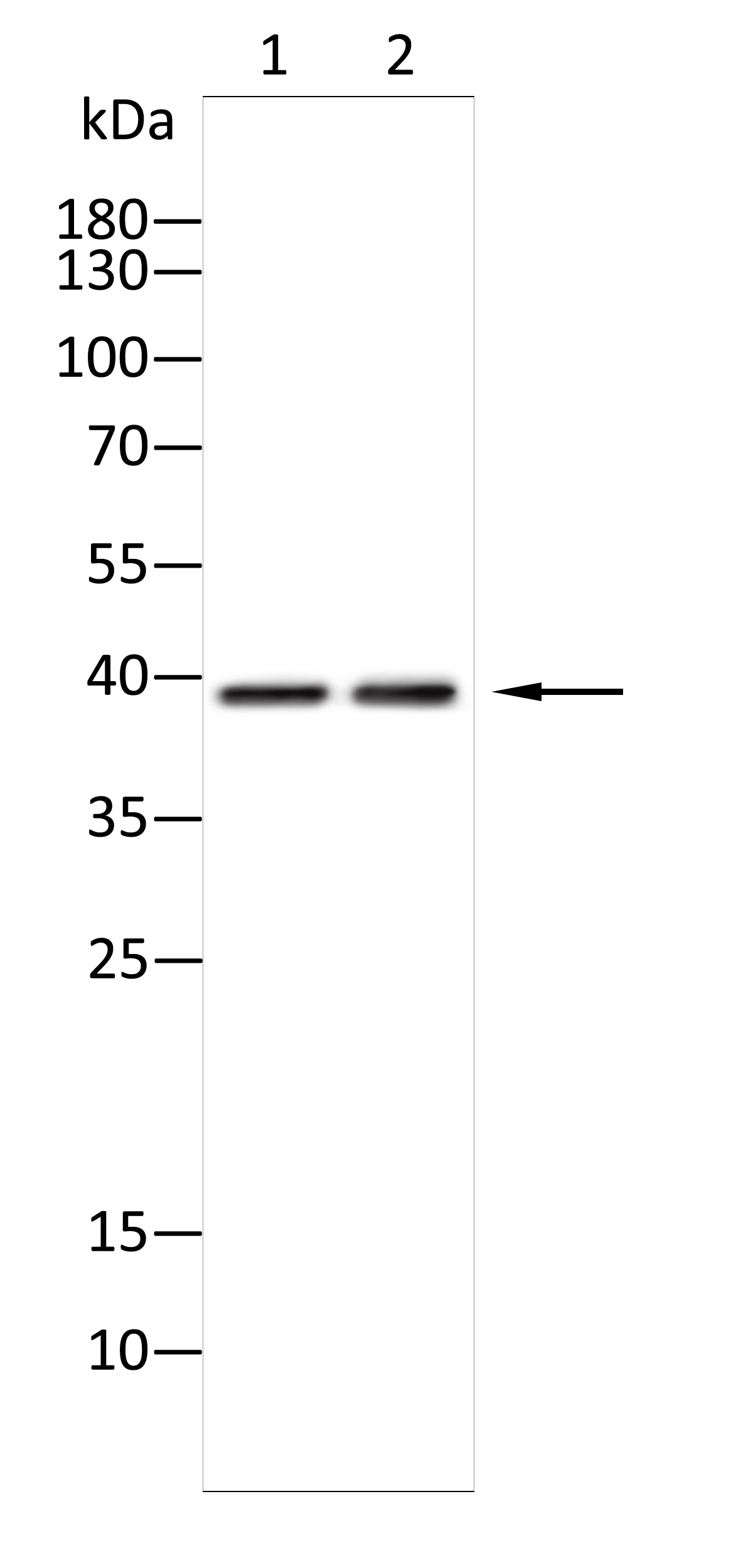
Western blot analysis using KIR3DL1 antibody against B16(1),Nih3t3(2) cell .| Product Name | Anti-KIR3DL1 antibody-poly-HRP |
|---|---|
| Antibody Type | Primary Antibodies |
| Immunogen | Polypeptide |
| Conjugation | poly-HRP |
| Clonality | Polyclonal |
|---|---|
| Isotype | IgG |
| Host Species | Rabbit |
| Species Reactivity | HumanMouseRat |
| Concentration | 1mg/ml |
| Purification | Protein A |
| Gene Symbol | KIR3DL1 |
|---|---|
| Gene Synonyms | CD158E1 KIR KIR3DL1/S1 NKAT-3 NKAT3 NKB1 NKB1B |
| Gene Full Name | killer cell immunoglobulin like receptor, three Ig domains and long cytoplasmic tail 1 |
| Gene Summary | Killer cell immunoglobulin-like receptors (KIRs) are transmembrane glycoproteins expressed by natural killer cells and subsets of T cells. The KIR genes are polymorphic and highly homologous and they are found in a cluster on chromosome 19q13.4 within the 1 Mb leukocyte receptor complex (LRC). The gene content of the KIR gene cluster varies among haplotypes, although several "framework" genes are found in all haplotypes (KIR3DL3, KIR3DP1, KIR3DL4, KIR3DL2). The KIR proteins are classified by the number of extracellular immunoglobulin domains (2D or 3D) and by whether they have a long (L) or short (S) cytoplasmic domain. KIR proteins with the long cytoplasmic domain transduce inhibitory signals upon ligand binding via an immune tyrosine-based inhibitory motif (ITIM), while KIR proteins with the short cytoplasmic domain lack the ITIM motif and instead associate with the TYRO protein tyrosine kinase binding protein to transduce activating signals. The ligands for several KIR proteins are subsets of HLA class I molecules; thus, KIR proteins are thought to play an important role in regulation of the immune response. [provided by RefSeq, Jul 2008] |
| Alternative Names | 3DL1 AMB11 CD158 antigen-like family member E CD158e antigen CD158E1/2 CD158E2 CL11 CL2 HLA-BW4-specific inhibitory NK cell receptor killer cell immunoglobulin-like receptor three domains long cytoplasmic tail 1 KIR antigen 3DL1 KIR G1 KIR3D KIR3DL1 KIR3DS1 MGC119726 MGC119728 MGC126589 MGC126591 natural killer cell receptor natural killer-associated transcript 3 NK receptor NKAT10 nkat3-delta-Ig1 putative p70 p70 killer cell inhibitory receptor p70 natural killer cell receptor clones CL-2/CL-11 p70 NK p70 NK receptor CL-2/CL-11 |
| Molecular Weight(MW) | 49kDa(observed:39kDa) |
| Cellular Localization | Cell membrane |
| SwissProt ID | P43629 |
|---|
WB
Western blot analysis using KIR3DL1 antibody against B16(1),Nih3t3(2) cell .| Form | Liquid |
|---|---|
| Storage Instructions | Shipped at 4°C. Store at +4°C short term (1-2 weeks). Store at -20°C long term. Avoid freeze / thaw cycle. |
| Storage Buffer | Purified antibody in PBS with 0.05% PC300,40% Glycerol. |


