ICC/IF
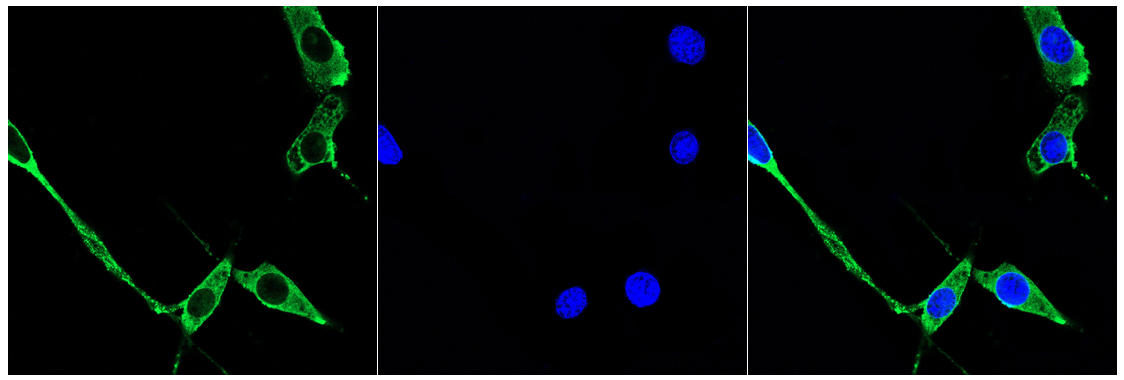
Immunofluorescence analysis of NIH3T3 cells using CD299 antibody (green). Blue: DAPI fluorescent DNA dye.Cells are fixed in 4% paraformaldehyde at room temperature for 15 minutes.| Product Name | Anti-CD299 antibody-AF488 |
|---|---|
| Antibody Type | Primary Antibodies |
| Immunogen | Polypeptide |
| Conjugation | AF488 |
| Clonality | Polyclonal |
|---|---|
| Isotype | IgG |
| Host Species | Rabbit |
| Species Reactivity | HumanMouseRat |
| Concentration | 1mg/ml |
| Purification | Protein A |
| Gene Symbol | CLEC4M |
|---|---|
| Gene Synonyms | CD209L CD209L1 CD299 DC-SIGN2 DC-SIGNR DCSIGNR HP10347 L-SIGN LSIGN |
| Gene Full Name | C-type lectin domain family 4 member M |
| Gene Summary | This gene encodes a C-type lectin that functions in cell adhesion and pathogen recognition. This receptor recognizes a wide range of evolutionarily divergent pathogens with a large impact on public health, including tuberculosis mycobacteria, and viruses including Ebola, hepatitis C, HIV-1, influenza A, West Nile virus and the SARS-CoV acute respiratory syndrome coronavirus. The protein is organized into four distinct domains: a C-terminal carbohydrate recognition domain, a flexible tandem-repeat neck domain of variable length, a transmembrane region and an N-terminal cytoplasmic domain involved in internalization. This gene is closely related in terms of both sequence and function to a neighboring gene, CD209 (Gene ID: 30835), also known as DC-SIGN. The two genes differ in viral recognition and expression patterns, with this gene showing high expression in endothelial cells of the liver, lymph node and placenta. Polymorphisms in the tandem repeat neck domain are associated with resistance to SARS infection. [provided by RefSeq, May 2020] |
| Alternative Names | C-type lectin CD209 antigen-like protein 1 CD299 antigen DC-SIGN-related protein dendritic cell-specific ICAM-3-grabbing non-integrin 2 liver/lymph node-specific ICAM-3 grabbing non-integrin mannose binding C-type lectin DC-SIGNR MGC129964 MGC47866 type II integral membrane protein |
| Molecular Weight(MW) | 45kDa |
| Cellular Localization | Membrane,Secreted |
| SwissProt ID | Q9H2X3 |
|---|
ICC/IF
Immunofluorescence analysis of NIH3T3 cells using CD299 antibody (green). Blue: DAPI fluorescent DNA dye.Cells are fixed in 4% paraformaldehyde at room temperature for 15 minutes.| Form | Liquid |
|---|---|
| Storage Instructions | Shipped at 4°C. Store at +4°C short term (1-2 weeks). Store at -20°C long term. Avoid freeze / thaw cycle. |
| Storage Buffer | Purified antibody in PBS with 0.05% PC300,40% Glycerol. |


