ICC/IF
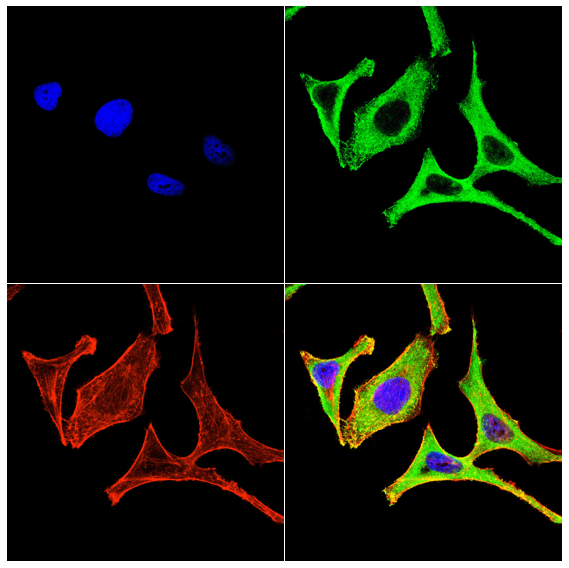
Immunofluorescence analysis of Hela cells using FASL antibody (green). Blue: DAPI fluorescent DNA dye. Red: Actin filaments have been labeled with Omnimabs® 594-Phalloidin.| Product Name | Anti-FASL antibody-AF488 |
|---|---|
| Antibody Type | Primary Antibodies |
| Immunogen | Polypeptide |
| Conjugation | AF488 |
| Clonality | Polyclonal |
|---|---|
| Isotype | IgG |
| Host Species | Rabbit |
| Species Reactivity | HumanMouseRat |
| Concentration | 1mg/ml |
| Purification | Protein A |
| Gene Symbol | FASLG |
|---|---|
| Gene Synonyms | ALPS1B APT1LG1 APTL CD178 CD95-L CD95L Fas-L FASL Faslg gld TNFSF6 TNLG1A |
| Gene Full Name | Fas ligand |
| Gene Summary | This gene is a member of the tumor necrosis factor superfamily. The primary function of the encoded transmembrane protein is the induction of apoptosis triggered by binding to FAS. The FAS/FASLG signaling pathway is essential for immune system regulation, including activation-induced cell death (AICD) of T cells and cytotoxic T lymphocyte induced cell death. It has also been implicated in the progression of several cancers. Defects in this gene may be related to some cases of systemic lupus erythematosus (SLE). Alternatively spliced transcript variants have been described. [provided by RefSeq, Nov 2014] |
| Alternative Names | Apoptosis (APO 1) antigen ligand 1 apoptosis (APO-1) antigen ligand 1 apoptosis antigen ligand CD178 CD178 antigen CD95 ligand CD95 ligand protein Generalized lymphoproliferative disease (Gld) cysteine-rich type II transmembrane protein/tumor necrosis factor receptor homolog Fas antigen ligand Fas ligand (TNF superfamily member 6) Fas-LG Fasl FasLs generalized lymphoproliferative disease mutant tumor necrosis factor family member 6 soluble form TNFL Tumor necrosis factor (ligand) superfamily member 6 Tumor necrosis factor ligand tumor necrosis factor ligand 1A Tumor necrosis factor ligand superfamily member 6 (TNFL6 / TNFSF6) |
| Molecular Weight(MW) | 31kDa |
| Cellular Localization | Cell membrane;Cytoplasmic vesicle lumen;Lysosome lumen;Secreted;Nucleus |
| SwissProt ID | P48023 |
|---|
ICC/IF
Immunofluorescence analysis of Hela cells using FASL antibody (green). Blue: DAPI fluorescent DNA dye. Red: Actin filaments have been labeled with Omnimabs® 594-Phalloidin.| Form | Liquid |
|---|---|
| Storage Instructions | Shipped at 4°C. Store at +4°C short term (1-2 weeks). Store at -20°C long term. Avoid freeze / thaw cycle. |
| Storage Buffer | Purified antibody in PBS with 0.05% PC300,40% Glycerol. |


