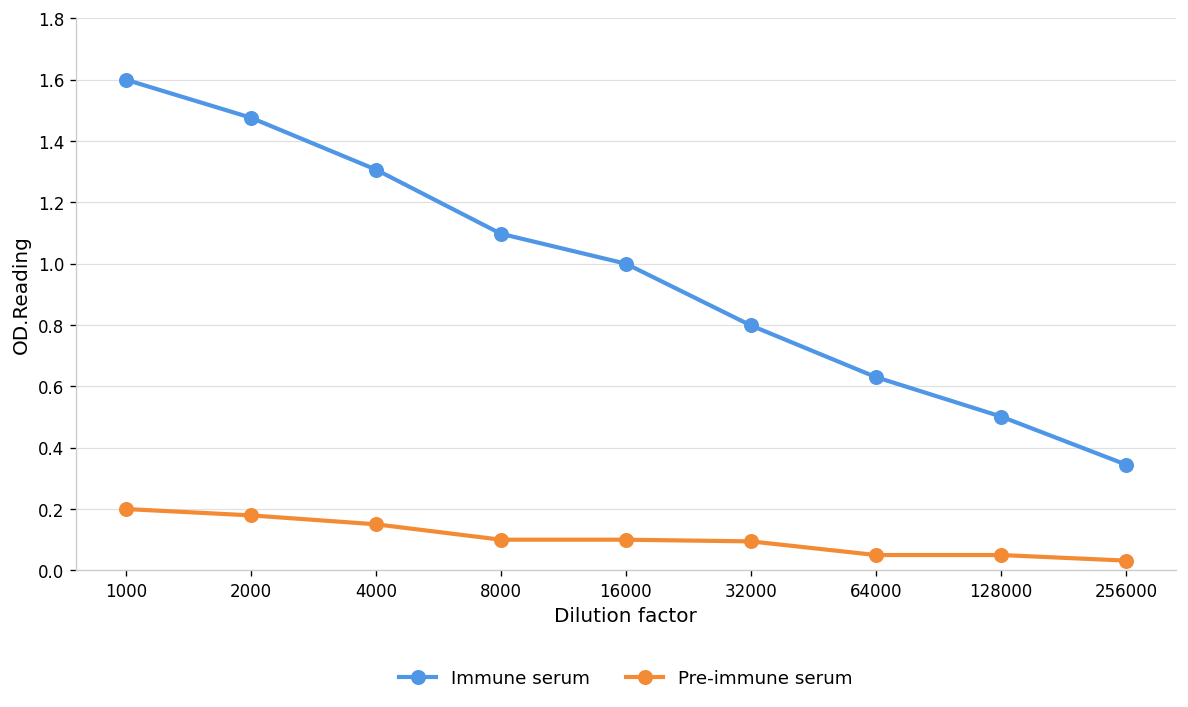
ELISA
Coat the plate with immunizing antigen.Blue line: Immune serum; Orange line: Pre-immune serum.| Product Name | Anti-GSTA1/A2/A3/A4/A5 antibody |
|---|---|
| Antibody Type | Primary Antibodies |
| Product description |
|
| Immunogen | Polypeptide |
| Clonality | Polyclonal |
|---|---|
| Isotype | IgG |
| Host Species | Rabbit |
| Tested Applications | ELISA |
| ELISA:1:1000-1:10000 |
|
| Species Reactivity | HumanMouseRat |
| Concentration | 1mg/ml |
| Purification | Protein A |
| Gene Symbol | GSTA1/GSTA2/GSTA3/Gsta4/GSTA5 |
|---|---|
| Gene Synonyms | GST 2-2 GST A3-3 GST AA GST Yc1 GST-epsilon GST2 Gst2-1 GSTA1-1 Gsta3 Gsta5 GTH1 Yc1/GST B Gsta1 GSTA2-2 Gstc-2 Gstc2 GTA2 GTH2/Gst2-3 GSTA3-3 Gsta5 GTA3 Yc2/GSTA4-4 GTA4/Gsta2 |
| Gene Full Name | glutathione S-transferase alpha 1/glutathione S-transferase alpha 2/glutathione S-transferase alpha 3/glutathione S-transferase, alpha 4/glutathione S-transferase alpha 5 |
| Gene Summary | This gene encodes a member of a family of enzymes that function to add glutathione to target electrophilic compounds, including carcinogens, therapeutic drugs, environmental toxins, and products of oxidative stress. This action is an important step in detoxification of these compounds. This subfamily of enzymes has a particular role in protecting cells from reactive oxygen species and the products of peroxidation. Polymorphisms in this gene influence the ability of individuals to metabolize different drugs. This gene is located in a cluster of similar genes and pseudogenes on chromosome 6. Alternative splicing results in multiple transcript variants. [provided by RefSeq, Jan 2016]/Cytosolic and membrane-bound forms of glutathione S-transferase are encoded by two distinct supergene families. These enzymes function in the detoxification of electrophilic compounds, including carcinogens, therapeutic drugs, environmental toxins and products of oxidative stress, by conjugation with glutathione. The genes encoding these enzymes are known to be highly polymorphic. These genetic variations can change an individual's susceptibility to carcinogens and toxins as well as affect the toxicity and efficacy of some drugs. At present, eight distinct classes of the soluble cytoplasmic mammalian glutathione S-transferases have been identified: alpha, kappa, mu, omega, pi, sigma, theta and zeta. This gene encodes a glutathione S-tranferase belonging to the alpha class. The alpha class genes, located in a cluster mapped to chromosome 6, are the most abundantly expressed glutathione S-transferases in liver. In addition to metabolizing bilirubin and certain anti-cancer drugs in the liver, the alpha class of these enzymes exhibit glutathione peroxidase activity thereby protecting the cells from reactive oxygen species and the products of peroxidation. [provided by RefSeq, Jul 2008]/Cytosolic and membrane-bound forms of glutathione S-transferase are encoded by two distinct supergene families. These enzymes are involved in cellular defense against toxic, carcinogenic, and pharmacologically active electrophilic compounds. At present, eight distinct classes of the soluble cytoplasmic mammalian glutathione S-transferases have been identified: alpha, kappa, mu, omega, pi, sigma, theta and zeta. This gene encodes a glutathione S-tranferase belonging to the alpha class genes that are located in a cluster mapped to chromosome 6. Genes of the alpha class are highly related and encode enzymes with glutathione peroxidase activity. However, during evolution, this alpha class gene diverged accumulating mutations in the active site that resulted in differences in substrate specificity and catalytic activity. The enzyme encoded by this gene catalyzes the double bond isomerization of precursors for progesterone and testosterone during the biosynthesis of steroid hormones. An additional transcript variant has been identified, but its full length sequence has not been determined. [provided by RefSeq, Jul 2008]/Predicted to enable glutathione transferase activity and toxic substance binding activity. Acts upstream of or within response to caloric restriction. Located in mitochondrion. Is expressed in several structures, including alimentary system; brain; genitourinary system; respiratory system; and sensory organ. [provided by Alliance of Genome Resources, Jul 2025]/The glutathione S-transferases (GST; EC 2.5.1.18) catalyze the conjugation of reduced glutathiones and a variety of electrophiles, including many known carcinogens and mutagens. The cytosolic GSTs belong to a large superfamily, with members located on different chromosomes. For additional information on GSTs, see GSTA1 (MIM 138359).[supplied by OMIM, Sep 2008] |
| Alternative Names | 13-hydroperoxyoctadecadienoate peroxidase androst-5-ene-3 17-dione isomerase class alpha detoxification enzyme glutathione S-alkyltransferase A1 glutathione S-aryltransferase A1 glutathione S-transferase (GST EC 2.5.1.18) glutathione S-transferase 2 glutathione S-transferase A1 glutathione S-transferase A3 subunit glutathione S-transferase A5 glutathione S-transferase Ha subunit 1 glutathione S-transferase Ha subunit 1 (EC 2.5.1.18) glutathione S-transferase Ya glutathione S-transferase Ya1 glutathione S-transferase Yc subunit glutathione S-transferase Yc1 subunit Glutathione-S-transferase alpha type (Ya) gluthione S-transferase subunit 1 (GST EC 2.5.1.18) GST GST class-alpha member 1 GST HA subunit 1 GSTA1 RP11-392A23.1 S-(hydroxyalkyl)glutathione lyase A1 testicular tissue protein Li 80/13-hydroperoxyoctadecadienoate peroxidase androst-5-ene-3 17-dione isomerase glutathione S-alkyltransferase A2 glutathione S-aralkyltransferase A2 glutathione S-aryltransferase A2 glutathione S-transferase A2 glutathione S-transferase GT41A glutathione S-transferase Ha subunit 2 (EC 2.5.1.18) glutathione S-transferase Ya subunit glutathione S-transferase Ya-1 glutathione transferase (EC 2.5.1.18) glutathione-S-transferase alpha type2 GST 1-1 GST 1a-1a GST A1-1 GST class-alpha member 2 GST HA subunit 2 GST Ya1 GST-gamma ligandin liver GST2 S-(hydroxyalkyl)glutathione lyase A2 testis tissue sperm-binding protein Li 59n/glutathione S-alkyltransferase A3 glutathione S-aralkyltransferase A3 glutathione S-aryltransferase A3 glutathione S-transferase A3 glutathione S-transferase A3-3 glutathione S-transferase Ya3 glutathione S-transferase Yc glutathione S-transferase Yc2 subunit GST A5-5 GST class-alpha member 3 GST Yc2 MGC22232 S-(hydroxyalkyl)glutathione lyase A3/glutathione S-alkyltransferase A4 glutathione S-aralkyltransferase A4 glutathione S-aryltransferase A4 glutathione S-transferase glutathione S-transferase A4 glutathione S-transferase A4-4 glutathione S-transferase Yk glutathione transferase glutathione transferase A4-4 GST 8-8 GST A4-4 GST class-alpha member 4 GST K GST Yk S-(hydroxyalkyl)glutathione lyase A4/GHS transferase glutathione S-transferase glutathione S-transferase A5-5 glutathione S-transferase Ya subunit glutathione S-transferase Ya-2 glutathione transferase YA subunit GST 1b-1b GST A2-2 GST class-alpha member 5 GST Ya2 |
| Molecular Weight(MW) | 25kDa |
| Source | Rabbit |
| Cellular Localization | Cytoplasm |
| SwissProt ID | P08263/P09210/Q16772/O15217/Q7RTV2 |
|---|
ELISA
Coat the plate with immunizing antigen.Blue line: Immune serum; Orange line: Pre-immune serum.| Application Notes | ELISA:1:1000-1:10000 |
|---|
| Form | Liquid |
|---|---|
| Storage Instructions | Shipped at 4°C. Store at +4°C short term (1-2 weeks). Store at -20°C long term. Avoid freeze / thaw cycle. |
| Storage Buffer | Purified antibody in PBS with 0.05% PC300,40% Glycerol. |


