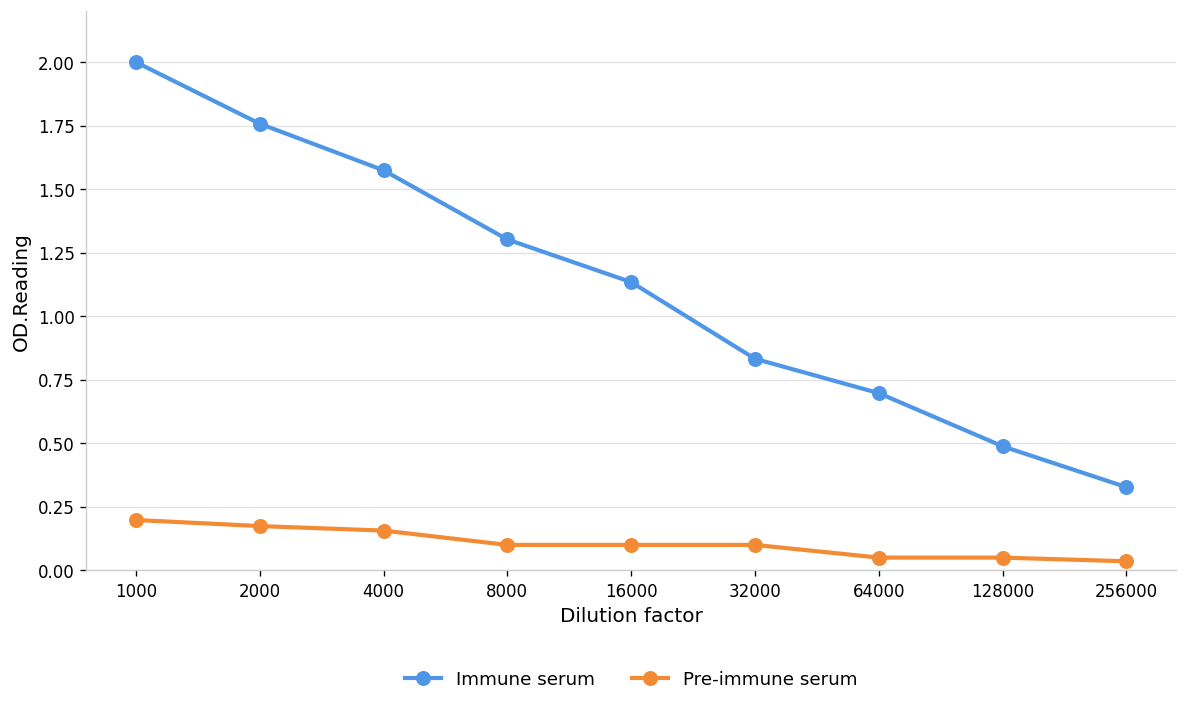
ELISA
Coat the plate with immunizing antigen.Blue line: Immune serum; Orange line: Pre-immune serum.| Product Name | Anti-ATP6V0D1/P39 antibody |
|---|---|
| Antibody Type | Primary Antibodies |
| Product description |
|
| Immunogen | Polypeptide |
| Clonality | Polyclonal |
|---|---|
| Isotype | IgG |
| Host Species | Rabbit |
| Tested Applications | ELISA |
| ELISA:1:1000-10000 |
|
| Species Reactivity | HumanMouseRat |
| Concentration | 1mg/ml |
| Purification | Protein A |
| Gene Symbol | ATP6V0D1 |
|---|---|
| Gene Synonyms | Ac39 ATP6D ATP6DV P39 VATX VMA6 VPATPD |
| Gene Full Name | ATPase H+ transporting V0 subunit d1 |
| Gene Summary | This gene encodes a component of vacuolar ATPase (V-ATPase), a multisubunit enzyme that mediates acidification of eukaryotic intracellular organelles. V-ATPase dependent organelle acidification is necessary for such intracellular processes as protein sorting, zymogen activation, receptor-mediated endocytosis, and synaptic vesicle proton gradient generation. V-ATPase is composed of a cytosolic V1 domain and a transmembrane V0 domain. The V1 domain consists of three A and three B subunits, two G subunits plus the C, D, E, F, and H subunits. The V1 domain contains the ATP catalytic site. The V0 domain consists of five different subunits: a, c, c', c'', and d. Additional isoforms of many of the V1 and V0 subunit proteins are encoded by multiple genes or alternatively spliced transcript variants. This encoded protein is known as the D subunit and is found ubiquitously. [provided by RefSeq, Jul 2008] |
| Alternative Names | 32 kDa accessory protein ATPase H+ transporting lysosomal (vacuolar proton pump) 42 kDa ATPase H+ transporting lysosomal (vacuolar proton pump) member D ATPase H+ transporting lysosomal 38kDa V0 subunit D ATPase H+ transporting lysosomal 38kDa V0 subunit d1 ATPase H+ transporting lysosomal V0 subunit D1 ATPase H+ transporting V0 subunit D FLJ43534 H(+)-transporting two-sector ATPase subunit D lysosomal 38kDa physophilin V-ATPase 40 KDa accessory protein V-ATPase AC39 subunit V-ATPase subunit d 1 V-ATPase subunit D V-type proton ATPa vacuolar proton pump subunit d 1 |
| Molecular Weight(MW) | 40kDa |
| Source | Rabbit |
| Cellular Localization | Membrane;Lysosome membrane;Cytoplasmic vesicle, clathrin-coated vesicle membrane |
| SwissProt ID | P61421 |
|---|
ELISA
Coat the plate with immunizing antigen.Blue line: Immune serum; Orange line: Pre-immune serum.| Application Notes | ELISA:1:1000-10000 |
|---|
| Form | Liquid |
|---|---|
| Storage Instructions | Shipped at 4°C. Store at +4°C short term (1-2 weeks). Store at -20°C long term. Avoid freeze / thaw cycle. |
| Storage Buffer | Purified antibody in PBS with 0.05% PC300,40% Glycerol. |


