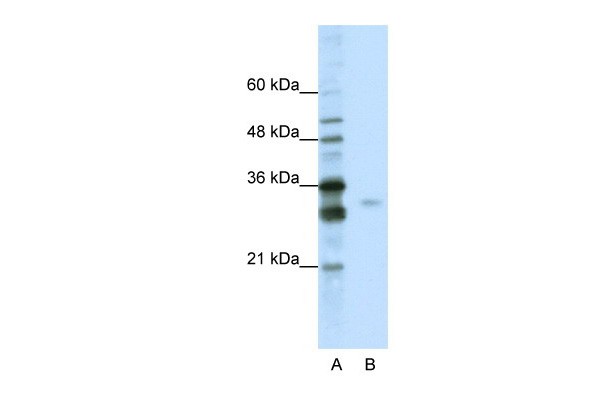
Western blot
0.2-1 ug/ml| Product Name | SFRS1 antibody - C-terminal region |
|---|---|
| Antibody Type | Primary Antibodies |
| Immunogen | The immunogen for anti-SFRS1 antibody: synthetic peptide directed towards the C terminal of human SFRS1 |
| Clonality | Polyclonal |
|---|---|
| Isotype | IgG |
| Host Species | Rabbit |
| Tested Applications | WB |
| Species Reactivity | Human |
| Concentration | 1mg/ml |
| Purification | Affinity purified |
| Gene Symbol | SFRS1 |
|---|---|
| Gene Synonyms | ASF SF2 SFRS1 SF2p33 SRp30a SRSF1 |
| Gene Full Name | Serine/arginine-rich splicing factor 1 |
| Gene Summary | SFRS1 is a member of the arginine/serine-rich splicing factor protein family, and functions in both constitutive and alternative pre-mRNA splicing. The protein binds to pre-mRNA transcripts and components of the spliceosome, and can either activate or repress splicing depending on the location of the pre-mRNA binding site. The protein's ability to activate splicing is regulated by phosphorylation and interactions with other splicing factor associated proteins. Multiple transcript variants encoding different isoforms have been found for this gene.Alternative mRNA splicing plays an important role in development and differentiation; many transcripts are spliced differently in distinct cell types and tissues. Both constitutive and alternative splicing occurs on spliceosomes, which are complex particles composed of small nuclear ribonucleoproteins (snRNPs) and non-snRNP proteins. The SR family of non-snRNP splicing factors is characterized by the presence of an RNA recognition motif and a serine- and arginine-rich (SR) domain. SR proteins are required at early stages of spliceosome assembly, have distinct but overlapping specificities for different pre-mRNAs, and can alter splice site choice, suggesting that they may be involved in the regulation of alternative splicing in vivo. Two of the SR proteins, ASF/SF2 (SFRS1) and SC35 (SFRS2; MIM 600813), have been extensively characterized.Alternative mRNA splicing plays an important role in development and differentiation; many transcripts are spliced differently in distinct cell types and tissues. Both constitutive and alternative splicing occurs on spliceosomes, which are complex particles composed of small nuclear ribonucleoproteins (snRNPs) and non-snRNP proteins. The SR family of non-snRNP splicing factors is characterized by the presence of an RNA recognition motif and a serine- and arginine-rich (SR) domain. SR proteins are required at early stages of spliceosome assembly, have distinct but overlapping specificities for different pre-mRNAs, and can alter splice site choice, suggesting that they may be involved in the regulation of alternative splicing in vivo. Two of the SR proteins, ASF/SF2 (SFRS1) and SC35 (SFRS2; MIM 600813), have been extensively characterized (Bermingham et al., 1995).[supplied by OMIM]. |
| Alternative Names | ASF SF2 SFRS1 SF2p33 SRp30a SRSF1 |
| Molecular Weight(MW) | 27kDa |
| Sequence | 248 amino acids |
Western blot
0.2-1 ug/ml| Form | Liquid |
|---|---|
| Storage Instructions | Aliquot and store at -20°C. Avoid repeated freeze / thaw cycles |
| Storage Buffer | phosphate buffered saline , pH 7.4, 150mM NaCl, 0.02% sodium azide and 50% glycerol. |


