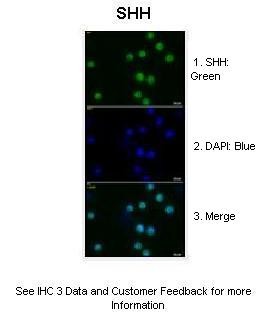
Immunohistochemical
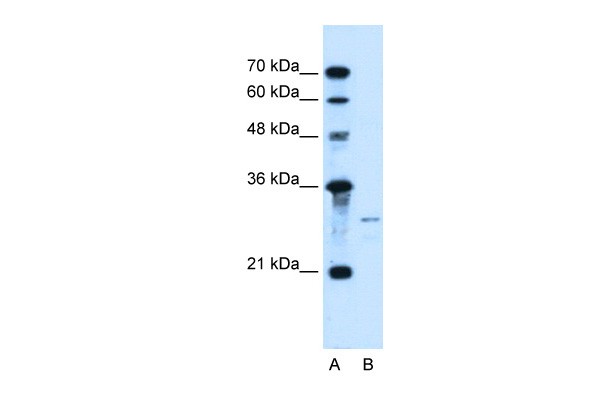
Human glioma cellsPrimary Antibody Dilution :1:200Secondary Antibody :Anti-rabbit-GFPSecondary Antibody Dilution :1:500Color/Signal Descriptions :1. SHH: Green 2. DAPI: Blue 3. MergeGene Name :SHHSubmitted by :ELIAS EL HABR, PhD, Post-Doctoral fellow, INSERM U894 Glial Plasticity Team, Psychiatry& Neurosciences Center, St Anne Hospital, 2 Ter, Rue d'Alesia, 75014 ParisWestern blot
0.2-1 ug/mlPositive Control: HepG2 cell lysate| Product Name | Rabbit anti-SHH polyclonal antibody - N-terminal region |
|---|---|
| Antibody Type | Primary Antibodies |
| Antigen Alias | HHG1, HLP3, HPE3, SMMCI, TPT, TPTPS, MCOPCB5 |
| Immunogen | The immunogen for anti-SHH antibody: synthetic peptide directed towards the N terminal of human SHH |
| Clonality | Polyclonal |
|---|---|
| Isotype | IgG |
| Host Species | Rabbit |
| Tested Applications | WBIHC |
| WB:1:500~1:2000 IHC:1:50~1:200 Notes:Optimal dilutions/concentrations should be determined by the researcher. |
|
| Species Reactivity | BovineDogGuinea PigHorseHumanMousePigRatZebra Fish |
| Concentration | 1mg/ml |
| Purification | Affinity purified |
| Gene Symbol | SHH |
|---|---|
| Gene Synonyms | HHG1 HLP3 HPE3 SMMCI TPT TPTPS MCOPCB5 |
| Gene Full Name | Sonic hedgehog |
| Gene Summary | SHH is a protein that is instrumental in patterning the early embryo. It has been implicated as the key inductive signal in patterning of the ventral neural tube, the anterior-posterior limb axis, and the ventral somites. Defects in this protein or in its signalling pathway are a cause of holoprosencephaly (HPE). It is also thought that mutations in its gene or in its signalling pathway may be responsible for VACTERL syndrome, which is characterized by vertebral defects, anal atresia, tracheoesophageal fistula with esophageal atresia, radial and renal dysplasia, cardiac anomalies, and limb abnormalities.This gene, which is expressed only during embryogenesis, encodes a protein that is instrumental in patterning the early embryo. It has been implicated as the key inductive signal in patterning of the ventral neural tube, the anterior-posterior limb axis, and the ventral somites. Of three human proteins showing sequence and functional similarity to the sonic hedgehog protein of Drosophila, this protein is the most similar. The protein is made as a precursor that is autocatalytically cleaved; the N-terminal portion is soluble and contains the signalling activity while the C-terminal portion is involved in precursor processing. More importantly, the C-terminal product covalently attaches a cholesterol moiety to the N-terminal product, restricting the N-terminal product to the cell surface and preventing it from freely diffusing throughout the developing embryo. Defects in this protein or in its signalling pathway are a cause of holoprosencephaly (HPE), a disorder in which the developing forebrain fails to correctly separate into right and left hemispheres. HPE is manifested by facial deformities. In addition, it is thought that mutations in this gene or in its signalling pathway may be responsible for VACTERL syndrome, which is characterized by vertebral defects, anal atresia, tracheoesophageal fistula with esophageal atresia, radial and renal dysplasia, cardiac anomalies, and limb abnormalities. |
| Alternative Names | HHG1 HLP3 HPE3 SMMCI TPT TPTPS MCOPCB5 |
| Molecular Weight(MW) | 28kDa |
| Sequence | 462 amino acids |
Immunohistochemical
Human glioma cellsPrimary Antibody Dilution :1:200Secondary Antibody :Anti-rabbit-GFPSecondary Antibody Dilution :1:500Color/Signal Descriptions :1. SHH: Green 2. DAPI: Blue 3. MergeGene Name :SHHSubmitted by :ELIAS EL HABR, PhD, Post-Doctoral fellow, INSERM U894 Glial Plasticity Team, Psychiatry& Neurosciences Center, St Anne Hospital, 2 Ter, Rue d'Alesia, 75014 Paris
Western blot
0.2-1 ug/mlPositive Control: HepG2 cell lysate| Application Notes | WB:1:500~1:2000 IHC:1:50~1:200 Notes:Optimal dilutions/concentrations should be determined by the researcher. |
|---|
| Form | Liquid |
|---|---|
| Storage Instructions | Aliquot and store at -20°C. Avoid repeated freeze / thaw cycles |
| Storage Buffer | phosphate buffered saline , pH 7.4, 150mM NaCl, 0.02% sodium azide and 50% glycerol. |


