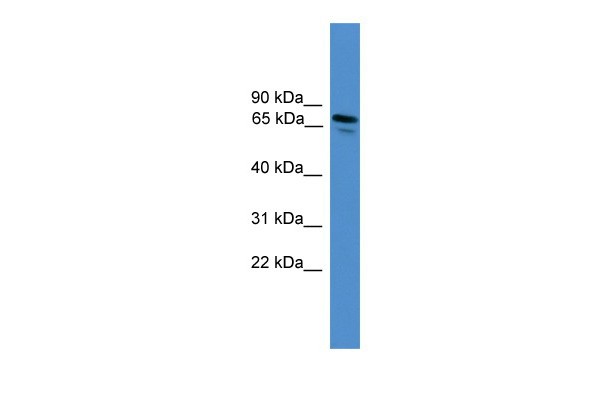
Western blot
0.2-1 ug/mlELISA Titer: 1:312500Positive Control: HepG2 cell lysate| Product Name | Rabbit anti-NRP1 polyclonal antibody - N-terminal region |
|---|---|
| Antibody Type | Primary Antibodies |
| Antigen Alias | BDCA4, CD304, DKFZp686A03134, DKFZp781F1414, NP1, NRP, VEGF165R |
| Product description | Immunogen Sequence comparison result: Bovine: 100%; Chicken: 100%; Dog: 100%; Guinea pig: 100%; Horse: 100%; Human: 100%; Mouse: 100%; Pig: 100%; Rabbit: 100%; Rat: 100%; African clawed frog: 92%; Zebrafish: 92% |
| Immunogen | The immunogen for anti-NRP1 antibody: synthetic peptide directed towards the N terminal of human NRP1 |
| Clonality | Polyclonal |
|---|---|
| Isotype | IgG |
| Host Species | Rabbit |
| Tested Applications | WB |
| WB:1:500~1:2000 Notes:Optimal dilutions/concentrations should be determined by the researcher. |
|
| Species Reactivity | BovineDogGuinea PigHorseHumanMousePigRabbitRatZebra Fish |
| Concentration | 1mg/ml |
| Purification | Affinity purified |
| Gene Symbol | NRP1 |
|---|---|
| Gene Synonyms | BDCA4 CD304 DKFZp686A03134 DKFZp781F1414 NP1 NRP VEGF165R |
| Gene Full Name | Neuropilin 1 |
| Gene Summary | NRP1 is a membrane-bound coreceptor to a tyrosine kinase receptor for both vascular endothelial growth factor (VEGF; MIM 192240) and semaphorin (see SEMA3A; MIM 603961) family members. NRP1 plays versatile roles in angiogenesis, axon guidance, cell survival, migration, and invasion. |
| Alternative Names | BDCA4 CD304 DKFZp686A03134 DKFZp781F1414 NP1 NRP VEGF165R |
| Molecular Weight(MW) | 72kDa |
| Sequence | 644 amino acids |
| Function | The membrane-bound isoform 1 is a receptor involved in the development of the cardiovascular system, in angiogenesis, in the formation of certain neuronal circuits and in organogenesis outside the nervous system. It mediates the chemorepulsant activity of semaphorins. It binds to semaphorin 3A, The PLGF-2 isoform of PGF, The VEGF-165 isoform of VEGF and VEGF-B. Coexpression with KDR results in increased VEGF-165 binding to KDR as well as increased chemotaxis. It may regulate VEGF-induced angiogenesis. The soluble isoform 2 binds VEGF-165 and appears to inhibit its binding to cells. It may also induce apoptosis by sequestering VEGF-165. May bind as well various members of the semaphorin family. Its expression has an averse effect on blood vessel number and integrity. |
| Sequence Similarities | Belongs to the neuropilin family. Contains 2 CUB domains. Contains 2 F5/8 type C domains. Contains 1 MAM domain. |
| Tissue Specificity | The expression of isoforms 1 and 2 does not seem to overlap. Isoform 1 is expressed by the blood vessels of different tissues. In the developing embryo it is found predominantly in the nervous system. In adult tissues, it is highly expressed in heart and placenta; moderately in lung, liver, skeletal muscle, kidney and pancreas; and low in adult brain. Isoform 2 is found in liver hepatocytes, kidney distal and proximal tubules. |
| Cellular Localization | Secreted and Cell membrane. |
| Entrez Gene | 8829 |
|---|---|
| SwissProt ID | O14786-2 |
| Protein Accession | NP_001019799 |
Western blot
0.2-1 ug/mlELISA Titer: 1:312500Positive Control: HepG2 cell lysate| Application Notes | WB:1:500~1:2000 Notes:Optimal dilutions/concentrations should be determined by the researcher. |
|---|
| Form | Liquid |
|---|---|
| Storage Instructions | Aliquot and store at -20°C. Avoid repeated freeze / thaw cycles |
| Storage Buffer | PBS buffer with 2% sucrose |


