Application
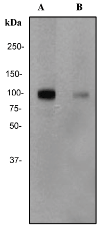
A. Western blot analysis on HEK293 cell lyasate using anti-MSK1 Phospho (pS360) RabMAb (Cat. #AJ1511a), dilution at 1:20,000. Cells were either (A) untreated or (B) treated with AP.| Product Name | MSK1 Antibody Phospho (pS360) |
|---|---|
| Antibody Type | Primary Antibodies |
| Antigen Alias | RPS6KA5, MSK1, Ribosomal protein S6 kinase alpha-5, Nuclear mitogen- and stress-activated protein kinase 1;90 kDa ribosomal protein S6 kinase 5;RSK-like protein kinase |
| Modification | p-S360 |
| Clonality | Monoclonal |
|---|---|
| Clone Number | EP1888Y |
| Host Species | Rabbit |
| Tested Applications | WB |
| WB:1:5000~50000 |
|
| Species Reactivity | Human |
| Concentration | 1mg/ml |
| Gene Synonyms | MSK1 |
|---|---|
| Alternative Names | RPS6KA5 MSK1 Ribosomal protein S6 kinase alpha-5 Nuclear mitogen- and stress-activated protein kinase 1 90 kDa ribosomal protein S6 kinase 5 RSK-like protein kinase |
| Molecular Weight(MW) | 89865 Da |
| Function | Serine/threonine-protein kinase that is required for the mitogen or stress-induced phosphorylation of the transcription factors CREB1 and ATF1 and for the regulation of the transcription factors RELA, STAT3 and ETV1/ER81, and that contributes to gene activation by histone phosphorylation and functions in the regulation of inflammatory genes. Phosphorylates CREB1 and ATF1 in response to mitogenic or stress stimuli such as UV-C irradiation, epidermal growth factor (EGF) and anisomycin. Plays an essential role in the control of RELA transcriptional activity in response to TNF and upon glucocorticoid, associates in the cytoplasm with the glucocorticoid receptor NR3C1 and contributes to RELA inhibition and repression of inflammatory gene expression. In skeletal myoblasts is required for phosphorylation of RELA at 'Ser-276' during oxidative stress. In erythropoietin-stimulated cells, is necessary for the 'Ser-727' phosphorylation of STAT3 and regulation of its transcriptional potential. Phosphorylates ETV1/ER81 at 'Ser-191' and 'Ser-216', and thereby regulates its ability to stimulate transcription, which may be important during development and breast tumor formation. Directly represses transcription via phosphorylation of 'Ser-1' of histone H2A Phosphorylates 'Ser-10' of histone H3 in response to mitogenics, stress stimuli and EGF, which results in the transcriptional activation of several immediate early genes, including proto- oncogenes c-fos/FOS and c-jun/JUN. May also phosphorylate 'Ser-28' of histone H3. Mediates the mitogen- and stress-induced phosphorylation of high mobility group protein 1 (HMGN1/HMG14). In lipopolysaccharide-stimulated primary macrophages, acts downstream of the Toll-like receptor TLR4 to limit the production of pro- inflammatory cytokines. Functions probably by inducing transcription of the MAP kinase phosphatase DUSP1 and the anti- inflammatory cytokine interleukin 10 (IL10), via CREB1 and ATF1 transcription factors. Plays a role in neuronal cell death by mediating the downstream effects of excitotoxic injury |
| Tissue Specificity | Widely expressed with high levels in heart, brain and placenta. Less abundant in lung, kidney and liver |
| Cellular Localization | Nucleus. Cytoplasm. Note=Predominantly nuclear. Exported into cytoplasm in response to glucocorticoid |
| Entrez Gene | 9252 |
|---|
Application
A. Western blot analysis on HEK293 cell lyasate using anti-MSK1 Phospho (pS360) RabMAb (Cat. #AJ1511a), dilution at 1:20,000. Cells were either (A) untreated or (B) treated with AP.| Application Notes | WB:1:5000~50000 |
|---|
| Form | Liquid |
|---|---|
| Storage Instructions | For short-term storage, store at 4° C. For long-term storage, aliquot and store at -20ºC or below. Avoid multiple freeze-thaw cycles. |
| Storage Buffer | 50 mM Tris-Glycine (pH 7.4), 0.15 M NaCl, 40% Glycerol, 0.01% sodium azide and 0.05% BSA. |


