Application
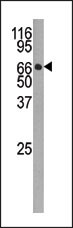
The anti-Phospho-APBB1-S175 Pab is used in Western blot to detect Phospho-APBB1-S175 in Y79 tissue lysate| Product Name | Phospho-APBB1-S175 Antibody |
|---|---|
| Antibody Type | Primary Antibodies |
| Modification | p-S175 |
| Clonality | Polyclonal |
|---|---|
| Isotype | Ig |
| Host Species | Rabbit |
| Tested Applications | WB |
| WB:1:100~500 |
|
| Species Reactivity | Human |
| Concentration | 1mg/ml |
| Gene Synonyms | FE65, RIR |
|---|---|
| Alternative Names | APBB1 FE65 RIR Amyloid beta A4 precursor protein-binding family B member 1 Protein Fe65 |
| Molecular Weight(MW) | 77244 Da |
| Function | Transcription coregulator that can have both coactivator and corepressor functions. Adapter protein that forms a transcriptionally active complex with the gamma-secretase-derived amyloid precursor protein (APP) intracellular domain. Plays a central role in the response to DNA damage by translocating to the nucleus and inducing apoptosis. May act by specifically recognizing and binding histone H2AX phosphorylated on 'Tyr-142' (H2AXY142ph) at double-strand breaks (DSBs), recruiting other pro- apoptosis factors such as MAPK8/JNK1. Required for histone H4 acetylation at double-strand breaks (DSBs). Its ability to specifically bind modified histones and chromatin modifying enzymes such as KAT5/TIP60, probably explains its trancription activation activity. Function in association with TSHZ3, SET and HDAC factors as a transcriptional repressor, that inhibits the expression of CASP4. Associates with chromatin in a region surrounding the CASP4 transcriptional start site(s) |
| Tissue Specificity | Highly expressed in brain; strongly reduced in post-mortem elderly subjects with Alzheimer disease |
| Cellular Localization | Cell membrane. Cytoplasm. Nucleus. Cell projection, growth cone (By similarity). Nucleus speckle Note=Colocalizes with TSHZ3 in axonal growth cone (By similarity) In normal conditions, it mainly localizes to the cytoplasm, while a small fraction is tethered to the cell membrane via its interaction with APP. Following exposure to DNA damaging agents, it is released from cell membrane and translocates to the nucleus Nuclear translocation is under the regulation of APP. Colocalizes with TSHZ3 in the nucleus. Co-localizes with NEK6 at the nuclear speckles. Phosphorylation at Ser-610 by SGK1 promotes its localization to the nucleus (By similarity) |
| Entrez Gene | 322 |
|---|
Application
The anti-Phospho-APBB1-S175 Pab is used in Western blot to detect Phospho-APBB1-S175 in Y79 tissue lysate| Application Notes | WB:1:100~500 |
|---|
| Form | Liquid |
|---|---|
| Storage Instructions | For short-term storage, store at 4° C. For long-term storage, aliquot and store at -20ºC or below. Avoid multiple freeze-thaw cycles. |
| Storage Buffer | Purified polyclonal antibody supplied in PBS with 0.09% (W/V) sodium azide. This antibody is first purified by protein G affinity chromatography. Then, the antibody fraction is peptide affinity purified in a 2-step procedure with control and phosphorylated peptides. The phospho-specific antibody is eluted with high and low pH buffers and neutralized immediately, followed by dialysis against PBS. |


