Application
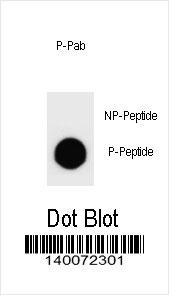
Dot blot analysis of Phospho-mouse ERBB2-Y1197 Antibody Phospho-specific Pab on nitrocellulose membrane. 50ng of Phospho-peptide or Non Phospho-peptide per dot were adsorbed. Antibody working concentrations are 0.6ug per ml.| Product Name | Phospho-mouse ERBB2-Y1197 |
|---|---|
| Antibody Type | Primary Antibodies |
| Antigen Alias | Erbb2; Kiaa3023; Neu; Receptor tyrosine-protein kinase erbB-2; Proto-oncogene Neu; Proto-oncogene c-ErbB-2; p185erbB2; CD_antigen=CD340; Flags: Precursor |
| Modification | p-Y1197 |
| Clonality | Polyclonal |
|---|---|
| Isotype | Ig |
| Host Species | Rabbit |
| Tested Applications | DB |
| DB:1:500 |
|
| Species Reactivity | Human |
| Concentration | 1mg/ml |
| Gene Synonyms | Kiaa3023 Neu |
|---|---|
| Alternative Names | Erbb2 Kiaa3023 Neu Receptor tyrosine-protein kinase erbB-2 Proto-oncogene Neu Proto-oncogene c-ErbB-2 p185erbB2 CD_antigen=CD340 Flags: Precursor |
| Molecular Weight(MW) | 138579 Da |
| Function | Protein tyrosine kinase that is part of several cell surface receptor complexes, but that apparently needs a coreceptor for ligand binding. Essential component of a neuregulin-receptor complex, although neuregulins do not interact with it alone. GP30 is a potential ligand for this receptor. Regulates outgrowth and stabilization of peripheral microtubules (MTs). Upon ERBB2 activation, the MEMO1-RHOA-DIAPH1 signaling pathway elicits the phosphorylation and thus the inhibition of GSK3B at cell membrane This prevents the phosphorylation of APC and CLASP2, allowing its association with the cell membrane. In turn, membrane-bound APC allows the localization of MACF1 to the cell membrane, which is required for microtubule capture and stabilization (By similarity) |
| Tissue Specificity | Expressed predominantly in uterine epithelial cells. In the muscle, expression localizes to the synaptic sites of muscle fibers |
| Cellular Localization | Cell membrane; Single-pass type I membrane protein (By similarity). Cytoplasm, perinuclear region (By similarity). Nucleus (By similarity) |
| Entrez Gene | 13866 |
|---|---|
| Nucleotide Accession | NP_001003817.1 |
Application
Dot blot analysis of Phospho-mouse ERBB2-Y1197 Antibody Phospho-specific Pab on nitrocellulose membrane. 50ng of Phospho-peptide or Non Phospho-peptide per dot were adsorbed. Antibody working concentrations are 0.6ug per ml.| Application Notes | DB:1:500 |
|---|
| Form | Liquid |
|---|---|
| Storage Instructions | For short-term storage, store at 4° C. For long-term storage, aliquot and store at -20ºC or below. Avoid multiple freeze-thaw cycles. |
| Storage Buffer | Purified polyclonal antibody supplied in PBS with 0.09% (W/V) sodium azide. This antibody is purified through a protein A column, followed by two-step phosphospecific peptide affinity purification. |


