Application
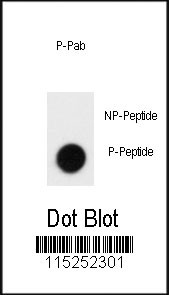
Dot blot analysis of anti-Phospho-SLAMF1-pY281 Antibody on nitrocellulose membrane. 50ng of Phospho-peptide or Non Phospho-peptide per dot were adsorbed. Antibody working concentrations are 0.5ug per ml.| Product Name | Phospho-SLAMF1-pY281 Antibody |
|---|---|
| Antibody Type | Primary Antibodies |
| Antigen Alias | SLAMF1; SLAM; Signaling lymphocytic activation molecule; CDw150; IPO-3; CD_antigen=CD150; Flags: Precursor |
| Modification | p-Y281 |
| Clonality | Polyclonal |
|---|---|
| Isotype | Ig |
| Host Species | Rabbit |
| Tested Applications | DB |
| DB:1:500 |
|
| Species Reactivity | Human |
| Concentration | 1mg/ml |
| Gene Synonyms | SLAM |
|---|---|
| Alternative Names | SLAMF1 SLAM Signaling lymphocytic activation molecule CDw150 IPO-3 CD_antigen=CD150 Flags: Precursor |
| Molecular Weight(MW) | 37231 Da |
| Function | High-affinity self-ligand important in bidirectional T- cell to B-cell stimulation. SLAM-induced signal-transduction events in T-lymphocytes are different from those in B-cells. Two modes of SLAM signaling are likely to exist: one in which the inhibitor SH2D1A acts as a negative regulator and another in which protein-tyrosine phosphatase 2C (PTPN11)-dependent signal transduction operates |
| Tissue Specificity | Constitutively expressed on peripheral blood memory T-cells, T-cell clones, immature thymocytes and a proportion of B-cells, and is rapidly induced on naive T-cells after activation |
| Cellular Localization | Cell membrane; Single-pass type I membrane protein. Note=Present on the surface of B-cells and T-cells |
| Entrez Gene | 6504 |
|---|
Application
Dot blot analysis of anti-Phospho-SLAMF1-pY281 Antibody on nitrocellulose membrane. 50ng of Phospho-peptide or Non Phospho-peptide per dot were adsorbed. Antibody working concentrations are 0.5ug per ml.| Application Notes | DB:1:500 |
|---|
| Form | Liquid |
|---|---|
| Storage Instructions | For short-term storage, store at 4° C. For long-term storage, aliquot and store at -20ºC or below. Avoid multiple freeze-thaw cycles. |
| Storage Buffer | Purified polyclonal antibody supplied in PBS with 0.09% (W/V) sodium azide. This antibody is purified through a protein A column, followed by two-step phosphospecific peptide affinity purification. |


