Application
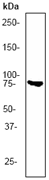
A. Western blot analysis on K562 cell lysate using anti-PKC beta II RabMAb (Cat. #AJ1618a), dilution 1:500Application
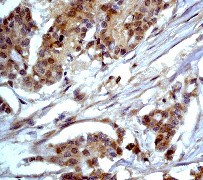
B. Immunohistochemical analysis of paraffin-embedded human breast carcinoma using anti- PKC beta II RabMAb (Cat. #AJ1618a).Application
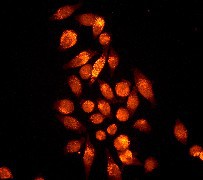
C. Immunofluorescent staining of HeLa cells using anti-PKC beta II RabMAb (Cat. #AJ1618a).| Product Name | PKC beta II Antibody |
|---|---|
| Antibody Type | Primary Antibodies |
| Antigen Alias | PRKCB, PKCB, PRKCB1, Protein kinase C beta type |
| Clonality | Monoclonal |
|---|---|
| Clone Number | Y125 |
| Host Species | Rabbit |
| Tested Applications | WBIHCIF |
| WB:1:500~10000 IHC |
|
| Species Reactivity | Human |
| Concentration | 1mg/ml |
| Gene Synonyms | PKCB PRKCB1 |
|---|---|
| Alternative Names | PRKCB PKCB PRKCB1 Protein kinase C beta type |
| Molecular Weight(MW) | 76869 Da |
| Function | Calcium-activated, phospholipid- and diacylglycerol (DAG)-dependent serine/threonine-protein kinase involved in various cellular processes such as regulation of the B-cell receptor (BCR) signalosome, oxidative stress-induced apoptosis, androgen receptor-dependent transcription regulation, insulin signaling and endothelial cells proliferation. Plays a key role in B-cell activation by regulating BCR-induced NF-kappa-B activation Mediates the activation of the canonical NF-kappa-B pathway (NFKB1) by direct phosphorylation of CARD11/CARMA1 at 'Ser-559', 'Ser-644' and 'Ser-652'. Phosphorylation induces CARD11/CARMA1 association with lipid rafts and recruitment of the BCL10-MALT1 complex as well as MAP3K7/TAK1, which then activates IKK complex, resulting in nuclear translocation and activation of NFKB1. Plays a direct role in the negative feedback regulation of the BCR signaling, by down-modulating BTK function via direct phosphorylation of BTK at 'Ser-180', which results in the alteration of BTK plasma membrane localization and in turn inhibition of BTK activity. Involved in apoptosis following oxidative damage: in case of oxidative conditions, specifically phosphorylates 'Ser-36' of isoform p66Shc of SHC1, leading to mitochondrial accumulation of p66Shc, where p66Shc acts as a reactive oxygen species producer. Acts as a coactivator of androgen receptor (ANDR)-dependent transcription, by being recruited to ANDR target genes and specifically mediating phosphorylation of 'Thr-6' of histone H3 (H3T6ph), a specific tag for epigenetic transcriptional activation that prevents demethylation of histone H3 'Lys-4' (H3K4me) by LSD1/KDM1A. In insulin signaling, may function downstream of IRS1 in muscle cells and mediate insulin-dependent DNA synthesis through the RAF1- MAPK/ERK signaling cascade. May participate in the regulation of glucose transport in adipocytes by negatively modulating the insulin-stimulated translocation of the glucose transporter SLC2A4/GLUT4. Under high glucose in pancreatic beta-cells, is probably involved in the inhibition of the insulin gene transcription, via regulation of MYC expression. In endothelial cells, activation of PRKCB induces increased phosphorylation of RB1, increased VEGFA-induced cell proliferation, and inhibits PI3K/AKT-dependent nitric oxide synthase (NOS3/eNOS) regulation by insulin, which causes endothelial dysfunction. Also involved in triglyceride homeostasis (By similarity) |
| Tissue Specificity | A synthetic peptide corresponding to residues near C-terminus of human PKC beta-II was used as immunogen. The antibody does not cross-react with human PKC beta-I. Predicted to cross-react with bovine PKC beta, and pig PKC beta-II, based on sequence homology |
| Cellular Localization | Cytoplasm (By similarity). Nucleus. Membrane; Peripheral membrane protein (By similarity) |
| Entrez Gene | 5579 |
|---|
Application
A. Western blot analysis on K562 cell lysate using anti-PKC beta II RabMAb (Cat. #AJ1618a), dilution 1:500
Application
B. Immunohistochemical analysis of paraffin-embedded human breast carcinoma using anti- PKC beta II RabMAb (Cat. #AJ1618a).
Application
C. Immunofluorescent staining of HeLa cells using anti-PKC beta II RabMAb (Cat. #AJ1618a).| Application Notes | WB:1:500~10000 IHC |
|---|
| Form | Liquid |
|---|---|
| Storage Instructions | For short-term storage, store at 4° C. For long-term storage, aliquot and store at -20ºC or below. Avoid multiple freeze-thaw cycles. |
| Storage Buffer | 50 mM Tris-Glycine (pH 7.4), 0.15 M NaCl, 40% Glycerol, 0.01% sodium azide and 0.05% BSA. |


