Application
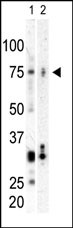
Western blot analysis of anti-CNK Pab in SK-BR3 cell lysate (Lane A) and mouse heart tissue lysate (Lane B). CNK (arrow) was detected using purified Pab. Secondary HRP-anti-rabbit was used for signal visualization with chemiluminescence.| Product Name | PLK3 Antibody (C-term) |
|---|---|
| Antibody Type | Primary Antibodies |
| Antigen Alias | PLK3; CNK; FNK; PRK; Serine/threonine-protein kinase PLK3; Cytokine-inducible serine/threonine-protein kinase; FGF-inducible kinase; Polo-like kinase 3; Proliferation-related kinase |
| Clonality | Polyclonal |
|---|---|
| Isotype | Ig |
| Host Species | Rabbit |
| Tested Applications | WB |
| WB:1:100~500 |
|
| Species Reactivity | Human |
| Concentration | 1mg/ml |
| Gene Synonyms | CNK FNK PRK |
|---|---|
| Alternative Names | PLK3 CNK FNK PRK Serine/threonine-protein kinase PLK3 Cytokine-inducible serine/threonine-protein kinase FGF-inducible kinase Polo-like kinase 3 Proliferation-related kinase |
| Molecular Weight(MW) | 71629 Da |
| Function | Serine/threonine-protein kinase involved in cell cycle regulation, response to stress and Golgi disassembly. Polo-like kinases act by binding and phosphorylating proteins are that already phosphorylated on a specific motif recognized by the POLO box domains. Phosphorylates ATF2, BCL2L1, CDC25A, CDC25C, CHEK2, HIF1A, JUN, p53/TP53, p73/TP73, PTEN, TOP2A and VRK1. Involved in cell cycle regulation: required for entry into S phase and cytokinesis. Phosphorylates BCL2L1, leading to regulate the G2 checkpoint and progression to cytokinesis during mitosis. Plays a key role in response to stress: rapidly activated upon stress stimulation, such as ionizing radiation, reactive oxygen species (ROS), hyperosmotic stress, UV irradiation and hypoxia. Involved in DNA damage response and G1/S transition checkpoint by phosphorylating CDC25A, p53/TP53 and p73/TP73. Phosphorylates p53/TP53 in response to reactive oxygen species (ROS), thereby promoting p53/TP53-mediated apoptosis. Phosphorylates CHEK2 in response to DNA damage, promoting the G2/M transition checkpoint Phosphorylates the transcription factor p73/TP73 in response to DNA damage, leading to inhibit p73/TP73-mediated transcriptional activation and pro-apoptotic functions. Phosphorylates HIF1A and JUN is response to hypoxia. Phosphorylates ATF2 following hyperosmotic stress in corneal epithelium. Also involved in Golgi disassembly during the cell cycle: part of a MEK1/MAP2K1-dependent pathway that induces Golgi fragmentation during mitosis by mediating phosphorylation of VRK1. May participate in endomitotic cell cycle, a form of mitosis in which both karyokinesis and cytokinesis are interrupted and is a hallmark of megakaryocyte differentiation, via its interaction with CIB1 |
| Tissue Specificity | Transcripts are highly detected in placenta, lung, followed by skeletal muscle, heart, pancreas, ovaries and kidney and weakly detected in liver and brain. May have a short half-live. In cells of hematopoietic origin, strongly and exclusively detected in terminally differentiated macrophages Transcript expression appears to be down-regulated in primary lung tumor |
| Cellular Localization | Cytoplasm. Nucleus. Nucleus, nucleolus. Golgi apparatus. Cytoplasm, cytoskeleton, centrosome Note=Translocates to the nucleus upon cisplatin treatment Localizes to the Golgi apparatus during interphase. According to a report, PLK3 localizes only in the nucleolus and not in the centrosome, or in any other location in the cytoplasm (PubMed:17264206). The discrepancies in results may be explained by the PLK3 antibody specificity, by cell line-specific expression or post-translational modifications |
| Entrez Gene | 1263 |
|---|
Application
Western blot analysis of anti-CNK Pab in SK-BR3 cell lysate (Lane A) and mouse heart tissue lysate (Lane B). CNK (arrow) was detected using purified Pab. Secondary HRP-anti-rabbit was used for signal visualization with chemiluminescence.| Application Notes | WB:1:100~500 |
|---|
| Form | Liquid |
|---|---|
| Storage Instructions | For short-term storage, store at 4° C. For long-term storage, aliquot and store at -20ºC or below. Avoid multiple freeze-thaw cycles. |
| Storage Buffer | Purified polyclonal antibody supplied in PBS with 0.09% (W/V) sodium azide. This antibody is purified through a protein G column, eluted with high and low pH buffers and neutralized immediately, followed by dialysis against PBS. |


