Application
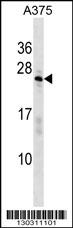
SARNP Antibody (Center) western blot analysis in A375 cell line lysates (35ug/lane).This demonstrates the SARNP antibody detected the SARNP protein (arrow).| Product Name | SARNP Antibody (Center) |
|---|---|
| Antibody Type | Primary Antibodies |
| Antigen Alias | SARNP; HCC1; SAP domain-containing ribonucleoprotein; Cytokine-induced protein of 29 kDa; Nuclear protein Hcc-1; Proliferation-associated cytokine-inducible protein CIP29 |
| Clonality | Polyclonal |
|---|---|
| Isotype | Ig |
| Host Species | Rabbit |
| Tested Applications | WB |
| WB:1:100~500 |
|
| Species Reactivity | Human |
| Concentration | 1mg/ml |
| Gene Synonyms | HCC1 |
|---|---|
| Alternative Names | SARNP HCC1 SAP domain-containing ribonucleoprotein Cytokine-induced protein of 29 kDa Nuclear protein Hcc-1 Proliferation-associated cytokine-inducible protein CIP29 |
| Molecular Weight(MW) | 23671 Da |
| Function | Binds both single-stranded and double-stranded DNA with higher affinity for the single-stranded form. Specifically binds to scaffold/matrix attachment region DNA. Also binds single- stranded RNA. Enhances RNA unwinding activity of DDX39A. May participate in important transcriptional or translational control of cell growth, metabolism and carcinogenesis |
| Tissue Specificity | Low expression in spleen, liver, pancreas, testis, thymus, heart, and kidney. Increased levels are seen in hepatocellular carcinoma and pancreatic adenocarcinoma |
| Cellular Localization | Nucleus. |
| Entrez Gene | 84324 |
|---|---|
| Nucleotide Accession | NP_149073.1 |
Application
SARNP Antibody (Center) western blot analysis in A375 cell line lysates (35ug/lane).This demonstrates the SARNP antibody detected the SARNP protein (arrow).| Application Notes | WB:1:100~500 |
|---|
| Form | Liquid |
|---|---|
| Storage Instructions | For short-term storage, store at 4° C. For long-term storage, aliquot and store at -20ºC or below. Avoid multiple freeze-thaw cycles. |
| Storage Buffer | Purified polyclonal antibody supplied in PBS with 0.09% (W/V) sodium azide. This antibody is purified through a protein A column, followed by peptide affinity purification. |


