Application
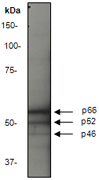
A. Western blot analysis on MCF-7 cell lysate using anti-SHC1 RabMAb (Cat. #AJ1713a), dilution 1:2,000.| Product Name | SHC1 Antibody |
|---|---|
| Antibody Type | Primary Antibodies |
| Antigen Alias | SHC1, SHC, SHCA, SHC-transforming protein 1, Src homology 2 domain-containing-transforming protein C1 |
| Clonality | Monoclonal |
|---|---|
| Clone Number | EP332Y |
| Host Species | Rabbit |
| Tested Applications | WB |
| WB:1:1000~10000 |
|
| Species Reactivity | Human |
| Concentration | 1mg/ml |
| Gene Synonyms | SHC SHCA |
|---|---|
| Alternative Names | SHC1 SHC SHCA SHC-transforming protein 1 Src homology 2 domain-containing-transforming protein C1 |
| Molecular Weight(MW) | 62822 Da |
| Function | Signaling adapter that couples activated growth factor receptors to signaling pathways. Participates in a signaling cascade initiated by activated KIT and KITLG/SCF. Isoform p46Shc and isoform p52Shc, once phosphorylated, couple activated receptor tyrosine kinases to Ras via the recruitment of the GRB2/SOS complex and are implicated in the cytoplasmic propagation of mitogenic signals. Isoform p46Shc and isoform p52Shc may thus function as initiators of the Ras signaling cascade in various non-neuronal systems. Isoform p66Shc does not mediate Ras activation, but is involved in signal transduction pathways that regulate the cellular response to oxidative stress and life span Isoform p66Shc acts as a downstream target of the tumor suppressor p53 and is indispensable for the ability of stress-activated p53 to induce elevation of intracellular oxidants, cytochrome c release and apoptosis. The expression of isoform p66Shc has been correlated with life span (By similarity). Participates in signaling downstream of the angiopoietin receptor TEK/TIE2, and plays a role in the regulation of endothelial cell migration and sprouting angiogenesis |
| Tissue Specificity | Widely expressed. Expressed in neural stem cells but absent in mature neurons |
| Cellular Localization | Cytoplasm. Isoform p66Shc: Mitochondrion (By similarity). Note=In case of oxidative conditions, phosphorylation at 'Ser-36' of isoform p66Shc, leads to mitochondrial accumulation (By similarity) |
| Entrez Gene | 6464 |
|---|
Application
A. Western blot analysis on MCF-7 cell lysate using anti-SHC1 RabMAb (Cat. #AJ1713a), dilution 1:2,000.| Application Notes | WB:1:1000~10000 |
|---|
| Form | Liquid |
|---|---|
| Storage Instructions | For short-term storage, store at 4° C. For long-term storage, aliquot and store at -20ºC or below. Avoid multiple freeze-thaw cycles. |
| Storage Buffer | 50 mM Tris-Glycine (pH 7.4), 0.15 M NaCl, 40% Glycerol, 0.01% sodium azide and 0.05% BSA. |


