Application
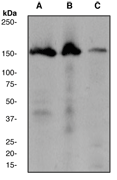
A. Western blot analysis on (A) HeLa (B) 293T and (C) NIH/3T3 cell lysates using anti- SMC1 RabMAb (Cat. #AJ1727a), 1:500 dilution.Application
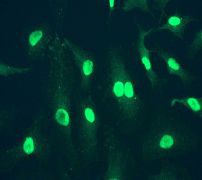
B. Immunofluorescent staining of HeLa cells using anti-SMC1 RabMAb (Cat. #AJ1727a).| Product Name | SMC1 Antibody |
|---|---|
| Antibody Type | Primary Antibodies |
| Antigen Alias | SMC1A, DXS423E, KIAA0178, SB1.8, SMC1, SMC1L1, Structural maintenance of chromosomes protein 1A, SMC1alpha protein;Sb1.8 |
| Clonality | Monoclonal |
|---|---|
| Clone Number | EP2878Y |
| Host Species | Rabbit |
| Tested Applications | WBIF |
| WB:1:500~1000 |
|
| Species Reactivity | Human |
| Concentration | 1mg/ml |
| Gene Synonyms | DXS423E KIAA0178 SB1.8 SMC1 SMC1L1 |
|---|---|
| Alternative Names | SMC1A DXS423E KIAA0178 SB1.8 SMC1 SMC1L1 Structural maintenance of chromosomes protein 1A SMC1alpha protein Sb1.8 |
| Molecular Weight(MW) | 143233 Da |
| Function | Involved in chromosome cohesion during cell cycle and in DNA repair. Central component of cohesin complex. The cohesin complex is required for the cohesion of sister chromatids after DNA replication. The cohesin complex apparently forms a large proteinaceous ring within which sister chromatids can be trapped At anaphase, the complex is cleaved and dissociates from chromatin, allowing sister chromatids to segregate. The cohesin complex may also play a role in spindle pole assembly during mitosis. Involved in DNA repair via its interaction with BRCA1 and its related phosphorylation by ATM, or via its phosphorylation by ATR. Works as a downstream effector both in the ATM/NBS1 branch and in the ATR/MSH2 branch of S-phase checkpoint |
| Tissue Specificity | A synthetic peptide corresponding to residues on the C-terminus of human SMC1 was used as an immunogen. |
| Cellular Localization | Nucleus. Chromosome. Chromosome, centromere, kinetochore. Note=Associates with chromatin. Before prophase it is scattered along chromosome arms. During prophase, most of cohesin complexes dissociate from chromatin probably because of phosphorylation by PLK, except at centromeres, where cohesin complexes remain. At anaphase, the RAD21 subunit of the cohesin complex is cleaved, leading to the dissociation of the complex from chromosomes, allowing chromosome separation. In germ cells, cohesin complex dissociates from chromatin at prophase I, and may be replaced by a meiosis-specific cohesin complex. The phosphorylated form on Ser-957 and Ser-966 associates with chromatin during G1/S/G2 phases but not during M phase, suggesting that phosphorylation does not regulate cohesin function. Integral component of the functional centromere-kinetochore complex at the kinetochore region during mitosis |
| Entrez Gene | 8243 |
|---|
Application
A. Western blot analysis on (A) HeLa (B) 293T and (C) NIH/3T3 cell lysates using anti- SMC1 RabMAb (Cat. #AJ1727a), 1:500 dilution.
Application
B. Immunofluorescent staining of HeLa cells using anti-SMC1 RabMAb (Cat. #AJ1727a).| Application Notes | WB:1:500~1000 |
|---|
| Form | Liquid |
|---|---|
| Storage Instructions | For short-term storage, store at 4° C. For long-term storage, aliquot and store at -20ºC or below. Avoid multiple freeze-thaw cycles. |
| Storage Buffer | 50 mM Tris-Glycine (pH 7.4), 0.15 M NaCl, 40% Glycerol, 0.01% sodium azide and 0.05% BSA. |


