Application
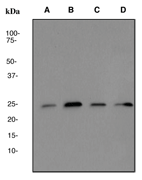
A. Western blot analysis on (A) Daudi (B) Jurkat (C) HepG2 (D) Hu-brain cell lysates using anti-UBC-1 RabMAb (Cat. #AJ1804b), dilution 1:500.| Product Name | UBC-1 Antibody |
|---|---|
| Antibody Type | Primary Antibodies |
| Antigen Alias | UBE2K, HIP2, LIG, Ubiquitin-conjugating enzyme E2 K, Ubiquitin-protein ligase;Ubiquitin carrier protein;Huntingtin-interacting protein 2 |
| Clonality | Monoclonal |
|---|---|
| Clone Number | EP1144Y |
| Host Species | Rabbit |
| Tested Applications | WB |
| WB:1:500~1000 |
|
| Species Reactivity | Human |
| Concentration | 1mg/ml |
| Gene Synonyms | HIP2 LIG |
|---|---|
| Alternative Names | UBE2K HIP2 LIG Ubiquitin-conjugating enzyme E2 K Ubiquitin-protein ligase Ubiquitin carrier protein Huntingtin-interacting protein 2 |
| Molecular Weight(MW) | 22407 Da |
| Function | Accepts ubiquitin from the E1 complex and catalyzes its covalent attachment to other proteins. In vitro, in the presence or in the absence of BRCA1-BARD1 E3 ubiquitin-protein ligase complex, catalyzes the synthesis of 'Lys-48'-linked polyubiquitin chains. Does not transfer ubiquitin directly to but elongates monoubiquitinated substrate protein. Mediates the selective degradation of short-lived and abnormal proteins, such as the endoplasmic reticulum-associated degradation (ERAD) of misfolded lumenal proteins. Ubiquitinates huntingtin. May mediate foam cell formation by the suppression of apoptosis of lipid-bearing macrophages through ubiquitination and subsequence degradation of p53/TP53. Proposed to be involved in ubiquitination and proteolytic processing of NF-kappa-B; in vitro supports ubiquitination of NFKB1. In case of infection by cytomegaloviruses may be involved in the US11-dependent degradation of MHC class I heavy chains following their export from the ER to the cytosol. In case of viral infections may be involved in the HPV E7 protein- dependent degradation of RB1 |
| Tissue Specificity | Expressed in all tissues tested, including spleen, thymus, prostate, testis, ovary, small intestine, colon, peripheral blood leukocytes, T-lymphocytes, monocytes, granulocytes and bone marrow mononuclear cells. Highly expressed in brain, with highest levels found in cortex and striatum and at lower levels in cerebellum and brainstem |
| Cellular Localization | Cytoplasm (By similarity). |
| Entrez Gene | 3093 |
|---|
Application
A. Western blot analysis on (A) Daudi (B) Jurkat (C) HepG2 (D) Hu-brain cell lysates using anti-UBC-1 RabMAb (Cat. #AJ1804b), dilution 1:500.| Application Notes | WB:1:500~1000 |
|---|
| Form | Liquid |
|---|---|
| Storage Instructions | For short-term storage, store at 4° C. For long-term storage, aliquot and store at -20ºC or below. Avoid multiple freeze-thaw cycles. |
| Storage Buffer | 50 mM Tris-Glycine (pH 7.4), 0.15 M NaCl, 40% Glycerol, 0.01% sodium azide and 0.05% BSA. |


