Application
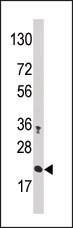
Western blot analysis of anti-CROC1A Pab in CEM cell line lysate (35ug/lane). CROC1A(arrow) was detected using the purified Pab.| Product Name | UBE2V1 (CROC1A) Antibody (C-term) |
|---|---|
| Antibody Type | Primary Antibodies |
| Antigen Alias | UBE2V1; CROC1; UBE2V; UEV1; Ubiquitin-conjugating enzyme E2 variant 1; CROC-1; TRAF6-regulated IKK activator 1 beta Uev1A |
| Clonality | Polyclonal |
|---|---|
| Isotype | Ig |
| Host Species | Rabbit |
| Tested Applications | WB |
| WB:1:100~500 |
|
| Species Reactivity | Human |
| Concentration | 1mg/ml |
| Gene Synonyms | CROC1 UBE2V UEV1 |
|---|---|
| Alternative Names | UBE2V1 CROC1 UBE2V UEV1 Ubiquitin-conjugating enzyme E2 variant 1 CROC-1 TRAF6-regulated IKK activator 1 beta Uev1A |
| Molecular Weight(MW) | 16495 Da |
| Function | Has no ubiquitin ligase activity on its own. The UBE2V1- UBE2N heterodimer catalyzes the synthesis of non-canonical poly- ubiquitin chains that are linked through Lys-63. This type of poly-ubiquitination activates IKK and does not seem to involve protein degradation by the proteasome. Plays a role in the activation of NF-kappa-B mediated by IL1B, TNF, TRAF6 and TRAF2 Mediates transcriptional activation of target genes. Plays a role in the control of progress through the cell cycle and differentiation. Plays a role in the error-free DNA repair pathway and contributes to the survival of cells after DNA damage Promotes TRIM5 capsid-specific restriction activity and the UBE2V1-UBE2N heterodimer acts in concert with TRIM5 to generate 'Lys-63'-linked polyubiquitin chains which activate the MAP3K7/TAK1 complex which in turn results in the induction and expression of NF-kappa-B and MAPK-responsive inflammatory genes |
| Tissue Specificity | Highly expressed in thyroid, pancreas, spinal cord, lymph node, trachea, adrenal gland, bone marrow and pancreas. Detected at low levels in heart, breast, placenta, brain, liver, kidney, stomach and lung |
| Cellular Localization | Nucleus. Note=Excluded from the nucleolus. |
| Entrez Gene | 7335 |
|---|
Application
Western blot analysis of anti-CROC1A Pab in CEM cell line lysate (35ug/lane). CROC1A(arrow) was detected using the purified Pab.| Application Notes | WB:1:100~500 |
|---|
| Form | Liquid |
|---|---|
| Storage Instructions | For short-term storage, store at 4° C. For long-term storage, aliquot and store at -20ºC or below. Avoid multiple freeze-thaw cycles. |
| Storage Buffer | Purified polyclonal antibody supplied in PBS with 0.09% (W/V) sodium azide. This antibody is purified through a protein G column, eluted with high and low pH buffers and neutralized immediately, followed by dialysis against PBS. |


