Application
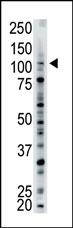
The anti-USP15 Pab is used in Western blot to detect USP15 in mouse brain tissue lysate.| Product Name | USP15 Antibody (N-term) |
|---|---|
| Antibody Type | Primary Antibodies |
| Clonality | Polyclonal |
|---|---|
| Isotype | Ig |
| Host Species | Rabbit |
| Tested Applications | WB |
| WB:1:100~500 |
|
| Species Reactivity | Human |
| Concentration | 1mg/ml |
| Gene Synonyms | KIAA0529 |
|---|---|
| Alternative Names | USP15 KIAA0529 Ubiquitin carboxyl-terminal hydrolase 15 Deubiquitinating enzyme 15 Ubiquitin thioesterase 15 Ubiquitin-specific-processing protease 15 Unph-2 Unph4 |
| Molecular Weight(MW) | 112419 Da |
| Function | Hydrolase that removes conjugated ubiquitin from target proteins and regulates various pathways such as the TGF-beta receptor signaling and NF-kappa-B pathways. Acts as a key regulator of TGF-beta receptor signaling pathway, but the precise mechanism is still unclear: according to a report, acts by promoting deubiquitination of monoubiquitinated R-SMADs (SMAD1, SMAD2 and/or SMAD3), thereby alleviating inhibition of R-SMADs and promoting activation of TGF-beta target genes (PubMed:21947082) According to another reports, regulates the TGF-beta receptor signaling pathway by mediating deubiquitination and stabilization of TGFBR1, leading to an enhanced TGF-beta signal (PubMed:22344298). Able to mediate deubiquitination of monoubiquitinated substrates as well as 'Lys-48'-linked polyubiquitin chains, protecting them against proteasomal degradation. Acts as an associated component of COP9 signalosome complex (CSN) and regulates different pathways via this association: regulates NF-kappa-B by mediating deubiquitination of NFKBIA and deubiquitinates substrates bound to VCP. Protects APC and human papillomavirus type 16 protein E6 against degradation via the ubiquitin proteasome pathway |
| Tissue Specificity | Expressed in skeletal muscle, kidney, heart, placenta, liver, thymus, lung, and ovary, with little or no expression in other tissues |
| Cellular Localization | Cytoplasm. Nucleus. |
Application
The anti-USP15 Pab is used in Western blot to detect USP15 in mouse brain tissue lysate.| Application Notes | WB:1:100~500 |
|---|
| Form | Liquid |
|---|---|
| Storage Instructions | For short-term storage, store at 4° C. For long-term storage, aliquot and store at -20ºC or below. Avoid multiple freeze-thaw cycles. |
| Storage Buffer | Purified polyclonal antibody supplied in PBS with 0.09% (W/V) sodium azide. This antibody is purified through a protein G column, eluted with high and low pH buffers and neutralized immediately, followed by dialysis against PBS. |


