Application
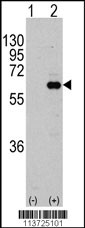
Western blot analysis of AKT3 (arrow) using rabbit polyclonal AKT3 Antibody (T447). 293 cell lysates (2 ug/lane) either nontransfected (Lane 1) or transiently transfected with the AKT3 gene (Lane 2) (Origene Technologies).| Product Name | AKT3 Antibody (T447) |
|---|---|
| Antibody Type | Primary Antibodies |
| Clonality | Polyclonal |
|---|---|
| Isotype | Ig |
| Host Species | Rabbit |
| Tested Applications | WB |
| WB:1:50~100 |
|
| Species Reactivity | Human |
| Concentration | 1mg/ml |
| Gene Synonyms | PKBG |
|---|---|
| Alternative Names | AKT3 PKBG RAC-gamma serine/threonine-protein kinase Protein kinase Akt-3 Protein kinase B gamma RAC-PK-gamma STK-2 |
| Molecular Weight(MW) | 55775 Da |
| Function | AKT3 is one of 3 closely related serine/threonine- protein kinases (AKT1, AKT2 and AKT3) called the AKT kinase, and which regulate many processes including metabolism, proliferation, cell survival, growth and angiogenesis. This is mediated through serine and/or threonine phosphorylation of a range of downstream substrates. Over 100 substrate candidates have been reported so far, but for most of them, no isoform specificity has been reported. AKT3 is the least studied AKT isoform. It plays an important role in brain development and is crucial for the viability of malignant glioma cells. AKT3 isoform may also be the key molecule in up-regulation and down-regulation of MMP13 via IL13. Required for the coordination of mitochondrial biogenesis with growth factor-induced increases in cellular energy demands Down-regulation by RNA interference reduces the expression of the phosphorylated form of BAD, resulting in the induction of caspase- dependent apoptosis |
| Tissue Specificity | In adult tissues, it is highly expressed in brain, lung and kidney, but weakly in heart, testis and liver. In fetal tissues, it is highly expressed in heart, liver and brain and not at all in kidney |
| Cellular Localization | Nucleus. Cytoplasm. Membrane; Peripheral membrane protein. Note=Membrane-associated after cell stimulation leading to its translocation |
| Entrez Gene | 10000 |
|---|
Application
Western blot analysis of AKT3 (arrow) using rabbit polyclonal AKT3 Antibody (T447). 293 cell lysates (2 ug/lane) either nontransfected (Lane 1) or transiently transfected with the AKT3 gene (Lane 2) (Origene Technologies).| Application Notes | WB:1:50~100 |
|---|
| Form | Liquid |
|---|---|
| Storage Instructions | For short-term storage, store at 4° C. For long-term storage, aliquot and store at -20ºC or below. Avoid multiple freeze-thaw cycles. |
| Storage Buffer | Purified rabbit polyclonal antibody supplied in PBS with 0.09% (W/V) sodium azide. This antibody is first purified by protein A affinity chromatography, followed by peptide affinity purification. |


