Application
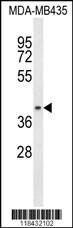
Western blot analysis of APG3 - cleaved.ctrl in MDA-MB435 cell line lysates (35ug/lane). APG3 (arrow) was detected using the purified Pab.Application
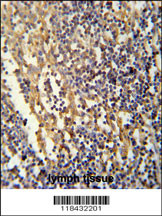
APG3 Antibody immunohistochemistry analysis in formalin fixed and paraffin embedded human lymph tissue followed by peroxidase conjugation of the secondary antibody and DAB staining. This data demonstrates the use of the APG3 Antibody for immunohistochemistry. Clinical relevance has not been evaluated.Application
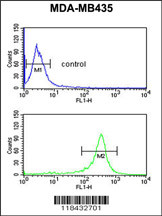
APG3 Antibody flow cytometric analysis of MDA-MB435 cells (bottom histogram) compared to a negative control cell (top histogram).FITC-conjugated goat-anti-rabbit secondary antibodies were used for the analysis.| Product Name | APG3 Antibody |
|---|---|
| Antibody Type | Primary Antibodies |
| Antigen Alias | ATG3; APG3; APG3L; Ubiquitin-like-conjugating enzyme ATG3; Autophagy-related protein 3; Protein PC3-96 |
| Clonality | Polyclonal |
|---|---|
| Isotype | Ig |
| Host Species | Rabbit |
| Tested Applications | WBIHCFC |
| WB:1:100~500 IHC |
|
| Species Reactivity | Human |
| Concentration | 1mg/ml |
| Gene Synonyms | APG3 APG3L |
|---|---|
| Alternative Names | ATG3 APG3 APG3L Ubiquitin-like-conjugating enzyme ATG3 Autophagy-related protein 3 Protein PC3-96 |
| Molecular Weight(MW) | 35864 Da |
| Function | E2-like enzyme involved in autophagy and mitochondrial homeostasis. Catalyzes the conjugation of ATG8-like proteins (GABARAP, GABARAPL1, GABARAPL2 or MAP1LC3A) to phosphatidylethanolamine (PE). PE-conjugation to ATG8-like proteins is essential for autophagy. Preferred substrate is MAP1LC3A. Also acts as an autocatalytic E2-like enzyme, catalyzing the conjugation of ATG12 to itself, ATG12 conjugation to ATG3 playing a role in mitochondrial homeostasis but not in autophagy ATG7 (E1-like enzyme) facilitates this reaction by forming an E1- E2 complex with ATG3 |
| Tissue Specificity | Widely expressed, with a highest expression in heart, skeletal muscle, kidney, liver and placenta |
| Cellular Localization | Cytoplasm. |
| Entrez Gene | 64422 |
|---|
Application
Western blot analysis of APG3 - cleaved.ctrl in MDA-MB435 cell line lysates (35ug/lane). APG3 (arrow) was detected using the purified Pab.
Application
APG3 Antibody immunohistochemistry analysis in formalin fixed and paraffin embedded human lymph tissue followed by peroxidase conjugation of the secondary antibody and DAB staining. This data demonstrates the use of the APG3 Antibody for immunohistochemistry. Clinical relevance has not been evaluated.
Application
APG3 Antibody flow cytometric analysis of MDA-MB435 cells (bottom histogram) compared to a negative control cell (top histogram).FITC-conjugated goat-anti-rabbit secondary antibodies were used for the analysis.| Application Notes | WB:1:100~500 IHC |
|---|
| Form | Liquid |
|---|---|
| Storage Instructions | For short-term storage, store at 4° C. For long-term storage, aliquot and store at -20ºC or below. Avoid multiple freeze-thaw cycles. |
| Storage Buffer | Purified polyclonal antibody supplied in PBS with 0.09% (W/V) sodium azide. This antibody is purified through a protein A column, followed by peptide affinity purification. |


