Application
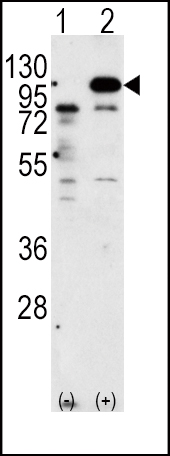
Western blot analysis of APP (arrow) using rabbit polyclonal APP Antibody (N-term) (RB05013). 293 cell lysates (2 ug/lane) either nontransfected (Lane 1) or transiently transfected with the APP gene (Lane 2) (Origene Technologies).Application
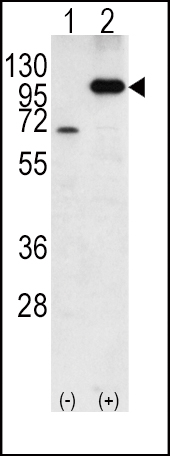
Western blot analysis of APP (arrow) using rabbit polyclonal APP Antibody (N-term) (RB05014). 293 cell lysates (2 ug/lane) either nontransfected (Lane 1) or transiently transfected with the APP gene (Lane 2) (Origene Technologies).| Product Name | APP Antibody (C-term) |
|---|---|
| Antibody Type | Primary Antibodies |
| Antigen Alias | APP; A4; AD1; Amyloid beta A4 protein; ABPP; APPI; Alzheimer disease amyloid protein; Cerebral vascular amyloid peptide; PreA4; Protease nexin-II; N-APP; Soluble APP-alpha; Soluble APP-beta; C99; Beta-amyloid protein 42; Beta-APP42; Beta-amyloid protein 40 |
| Clonality | Polyclonal |
|---|---|
| Isotype | Ig |
| Host Species | Rabbit |
| Tested Applications | WB |
| WB:1:100~500 |
|
| Species Reactivity | Human |
| Concentration | 1mg/ml |
| Gene Synonyms | A4 AD1 |
|---|---|
| Alternative Names | APP A4 AD1 Amyloid beta A4 protein ABPP APPI Alzheimer disease amyloid protein Cerebral vascular amyloid peptide PreA4 Protease nexin-II N-APP Soluble APP-alpha Soluble APP-beta C99 Beta-amyloid protein 42 Beta-APP42 Beta-amyloid protein 40 |
| Molecular Weight(MW) | 86943 Da |
| Function | Functions as a cell surface receptor and performs physiological functions on the surface of neurons relevant to neurite growth, neuronal adhesion and axonogenesis. Involved in cell mobility and transcription regulation through protein-protein interactions. Can promote transcription activation through binding to APBB1-KAT5 and inhibits Notch signaling through interaction with Numb. Couples to apoptosis-inducing pathways such as those mediated by G(O) and JIP. Inhibits G(o) alpha ATPase activity (By similarity). Acts as a kinesin I membrane receptor, mediating the axonal transport of beta-secretase and presenilin 1. Involved in copper homeostasis/oxidative stress through copper ion reduction In vitro, copper-metallated APP induces neuronal death directly or is potentiated through Cu(2+)-mediated low-density lipoprotein oxidation. Can regulate neurite outgrowth through binding to components of the extracellular matrix such as heparin and collagen I and IV. The splice isoforms that contain the BPTI domain possess protease inhibitor activity. Induces a AGER- dependent pathway that involves activation of p38 MAPK, resulting in internalization of amyloid-beta peptide and leading to mitochondrial dysfunction in cultured cortical neurons. Provides Cu(2+) ions for GPC1 which are required for release of nitric oxide (NO) and subsequent degradation of the heparan sulfate chains on GPC1 Appicans elicit adhesion of neural cells to the extracellular matrix and may regulate neurite outgrowth in the brain (By similarity) N-APP binds TNFRSF21 triggering caspase activation and degeneration of both neuronal cell bodies (via caspase-3) and axons (via caspase-6) |
| Tissue Specificity | Expressed in all fetal tissues examined with highest levels in brain, kidney, heart and spleen. Weak expression in liver. In adult brain, highest expression found in the frontal lobe of the cortex and in the anterior perisylvian cortex- opercular gyri. Moderate expression in the cerebellar cortex, the posterior perisylvian cortex-opercular gyri and the temporal associated cortex. Weak expression found in the striate, extra- striate and motor cortices. Expressed in cerebrospinal fluid, and plasma. Isoform APP695 is the predominant form in neuronal tissue, isoform APP751 and isoform APP770 are widely expressed in non- neuronal cells. Isoform APP751 is the most abundant form in T- lymphocytes. Appican is expressed in astrocytes |
| Cellular Localization | Membrane; Single-pass type I membrane protein. Membrane, clathrin-coated pit. Note=Cell surface protein that rapidly becomes internalized via clathrin-coated pits. During maturation, the immature APP (N-glycosylated in the endoplasmic reticulum) moves to the Golgi complex where complete maturation occurs (O-glycosylated and sulfated). After alpha-secretase cleavage, soluble APP is released into the extracellular space and the C-terminal is internalized to endosomes and lysosomes. Some APP accumulates in secretory transport vesicles leaving the late Golgi compartment and returns to the cell surface. Gamma-CTF(59) peptide is located to both the cytoplasm and nuclei of neurons. It can be translocated to the nucleus through association with APBB1 (Fe65). Beta-APP42 associates with FRPL1 at the cell surface and the complex is then rapidly internalized. APP sorts to the basolateral surface in epithelial cells. During neuronal differentiation, the Thr-743 phosphorylated form is located mainly in growth cones, moderately in neurites and sparingly in the cell body. Casein kinase phosphorylation can occur either at the cell surface or within a post-Golgi compartment. Associates with GPC1 in perinuclear compartments |
| Entrez Gene | 351 |
|---|
Application
Western blot analysis of APP (arrow) using rabbit polyclonal APP Antibody (N-term) (RB05013). 293 cell lysates (2 ug/lane) either nontransfected (Lane 1) or transiently transfected with the APP gene (Lane 2) (Origene Technologies).
Application
Western blot analysis of APP (arrow) using rabbit polyclonal APP Antibody (N-term) (RB05014). 293 cell lysates (2 ug/lane) either nontransfected (Lane 1) or transiently transfected with the APP gene (Lane 2) (Origene Technologies).| Application Notes | WB:1:100~500 |
|---|
| Form | Liquid |
|---|---|
| Storage Instructions | For short-term storage, store at 4° C. For long-term storage, aliquot and store at -20ºC or below. Avoid multiple freeze-thaw cycles. |
| Storage Buffer | Purified polyclonal antibody supplied in PBS with 0.09% (W/V) sodium azide. This antibody is purified through a protein G column, eluted with high and low pH buffers and neutralized immediately, followed by dialysis against PBS. |


