Application
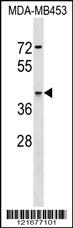
ARSA Antibody (C-term) western blot analysis in MDA-MB453 cell line lysates (35ug/lane).This demonstrates the ARSA antibody detected the ARSA protein (arrow).| Product Name | ARSA Antibody (C-term) |
|---|---|
| Antibody Type | Primary Antibodies |
| Antigen Alias | ASNA1; ARSA; TRC40; ATPase ASNA1; Arsenical pump-driving ATPase; Arsenite-stimulated ATPase; Transmembrane domain recognition complex 40 kDa ATPase subunit; hARSA-I; hASNA-I |
| Clonality | Polyclonal |
|---|---|
| Isotype | Ig |
| Host Species | Rabbit |
| Tested Applications | WB |
| WB:1:100~500 |
|
| Species Reactivity | Human |
| Concentration | 1mg/ml |
| Gene Synonyms | ARSA TRC40 |
|---|---|
| Alternative Names | ASNA1 ARSA TRC40 ATPase ASNA1 Arsenical pump-driving ATPase Arsenite-stimulated ATPase Transmembrane domain recognition complex 40 kDa ATPase subunit hARSA-I hASNA-I |
| Molecular Weight(MW) | 38793 Da |
| Function | ATPase required for the post-translational delivery of tail-anchored (TA) proteins to the endoplasmic reticulum Recognizes and selectively binds the transmembrane domain of TA proteins in the cytosol. This complex then targets to the endoplasmic reticulum by membrane-bound receptors, where the tail- anchored protein is released for insertion. This process is regulated by ATP binding and hydrolysis. ATP binding drives the homodimer towards the closed dimer state, facilitating recognition of newly synthesized TA membrane proteins. ATP hydrolysis is required for insertion. Subsequently, the homodimer reverts towards the open dimer state, lowering its affinity for the membrane-bound receptor, and returning it to the cytosol to initiate a new round of targeting (By similarity). May be involved in insulin signaling |
| Tissue Specificity | Expressed in the epithelial cells of the liver, kidney, and stomach wall, in the adrenal medulla, in the islet cells of the pancreas, in the red pulp of the spleen, and in cardiac and skeletal muscle |
| Cellular Localization | Cytoplasm. Endoplasmic reticulum. Nucleus, nucleolus |
| Entrez Gene | 439 |
|---|---|
| Nucleotide Accession | NP_004308.2 |
Application
ARSA Antibody (C-term) western blot analysis in MDA-MB453 cell line lysates (35ug/lane).This demonstrates the ARSA antibody detected the ARSA protein (arrow).| Application Notes | WB:1:100~500 |
|---|
| Form | Liquid |
|---|---|
| Storage Instructions | For short-term storage, store at 4° C. For long-term storage, aliquot and store at -20ºC or below. Avoid multiple freeze-thaw cycles. |
| Storage Buffer | Purified polyclonal antibody supplied in PBS with 0.09% (W/V) sodium azide. This antibody is purified through a protein A column, followed by peptide affinity purification. |


