Application
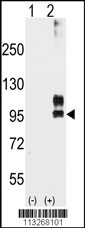
Western blot analysis of APG9L1 (arrow) using rabbit polyclonal APG9L1 Antibody (S828) . 293 cell lysates (2 ug/lane) either nontransfected (Lane 1) or transiently transfected with the APG9L1 gene (Lane 2) (Origene Technologies).| Product Name | ATG9A Antibody |
|---|---|
| Antibody Type | Primary Antibodies |
| Clonality | Polyclonal |
|---|---|
| Isotype | Ig |
| Host Species | Rabbit |
| Tested Applications | WB |
| WB:1:50~100 |
|
| Species Reactivity | Human |
| Concentration | 1mg/ml |
| Gene Synonyms | APG9L1 |
|---|---|
| Alternative Names | ATG9A APG9L1 Autophagy-related protein 9A APG9-like 1 mATG9 |
| Molecular Weight(MW) | 94447 Da |
| Function | Plays a role in autophagy. Cycles between a juxta- nuclear trans-Golgi network compartment and late endosomes Nutrient starvation induces accumulation on autophagosomes Starvation-dependent trafficking requires ULK1, ATG13 and SUPT20H |
| Tissue Specificity | This ATG9A antibody is generated from rabbits immunized with a KLH conjugated synthetic peptide between 810~839 amino acids surrounding S828 of human APG9L1. |
| Cellular Localization | Cytoplasmic vesicle, autophagosome membrane; Multi-pass membrane protein (By similarity). Golgi apparatus, trans-Golgi network membrane; Multi-pass membrane protein. Late endosome membrane; Multi-pass membrane protein |
| Entrez Gene | 79065 |
|---|
Application
Western blot analysis of APG9L1 (arrow) using rabbit polyclonal APG9L1 Antibody (S828) . 293 cell lysates (2 ug/lane) either nontransfected (Lane 1) or transiently transfected with the APG9L1 gene (Lane 2) (Origene Technologies).| Application Notes | WB:1:50~100 |
|---|
| Form | Liquid |
|---|---|
| Storage Instructions | For short-term storage, store at 4° C. For long-term storage, aliquot and store at -20ºC or below. Avoid multiple freeze-thaw cycles. |
| Storage Buffer | Purified rabbit polyclonal antibody supplied in PBS with 0.09% (W/V) sodium azide. This antibody is purified through a protein G column, eluted with high and low pH buffers and neutralized immediately, followed by dialysis against PBS. |


