Application
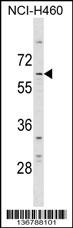
DCP1A Antibody (N-term) western blot analysis in NCI-H460 cell line lysates (35ug/lane).This demonstrates the DCP1A antibody detected the DCP1A protein (arrow).| Product Name | DCP1A Antibody (N-term) |
|---|---|
| Antibody Type | Primary Antibodies |
| Antigen Alias | DCP1A; SMIF; mRNA-decapping enzyme 1A; Smad4-interacting transcriptional co-activator; Transcription factor SMIF |
| Clonality | Polyclonal |
|---|---|
| Isotype | Ig |
| Host Species | Rabbit |
| Tested Applications | WB |
| WB:1:100~500 |
|
| Species Reactivity | Human |
| Concentration | 1mg/ml |
| Gene Synonyms | SMIF |
|---|---|
| Alternative Names | DCP1A SMIF mRNA-decapping enzyme 1A Smad4-interacting transcriptional co-activator Transcription factor SMIF |
| Molecular Weight(MW) | 63309 Da |
| Function | Necessary for the degradation of mRNAs, both in normal mRNA turnover and in nonsense-mediated mRNA decay. Removes the 7- methyl guanine cap structure from mRNA molecules, yielding a 5'- phosphorylated mRNA fragment and 7m-GDP. Contributes to the transactivation of target genes after stimulation by TGFB1 |
| Tissue Specificity | Detected in heart, brain, placenta, lung, skeletal muscle, liver, kidney and pancreas |
| Cellular Localization | Cytoplasm, P-body. Nucleus. Note=Co- localizes with NANOS3 in the processing bodies (By similarity) Predominantly cytoplasmic, in processing bodies (PB). Nuclear, after TGFB1 treatment. Translocation to the nucleus depends on interaction with SMAD4 |
| Entrez Gene | 55802 |
|---|---|
| Nucleotide Accession | NP_060873.4 |
Application
DCP1A Antibody (N-term) western blot analysis in NCI-H460 cell line lysates (35ug/lane).This demonstrates the DCP1A antibody detected the DCP1A protein (arrow).| Application Notes | WB:1:100~500 |
|---|
| Form | Liquid |
|---|---|
| Storage Instructions | For short-term storage, store at 4° C. For long-term storage, aliquot and store at -20ºC or below. Avoid multiple freeze-thaw cycles. |
| Storage Buffer | Purified polyclonal antibody supplied in PBS with 0.09% (W/V) sodium azide. This antibody is purified through a protein A column, followed by peptide affinity purification. |


