Application
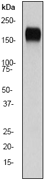
A. Western blot analysis on HeLa cell lysate using anti-EGFR RabMAb (Cat. #AJ1252b), dilution 1:100,000Application
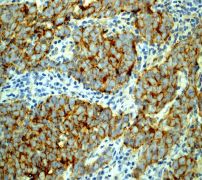
B. Immunohistochemical staining of paraffin-embedded human lymph node metastasis using anti-EGFR RabMAb (Cat. #AJ1252b).| Product Name | EGFR Antibody |
|---|---|
| Antibody Type | Primary Antibodies |
| Clonality | Monoclonal |
|---|---|
| Clone Number | EP38Y |
| Host Species | Rabbit |
| Tested Applications | WBIHC |
| WB:1:10000 IHC |
|
| Species Reactivity | Human |
| Concentration | 1mg/ml |
| Gene Synonyms | ERBB, ERBB1, HER1 |
|---|---|
| Alternative Names | EGFR ERBB1 Epidermal growth factor receptor Receptor tyrosine-protein kinase ErbB-1 |
| Molecular Weight(MW) | 134277 Da |
| Function | Receptor tyrosine kinase binding ligands of the EGF family and activating several signaling cascades to convert extracellular cues into appropriate cellular responses. Known ligands include EGF, TGFA/TGF-alpha, amphiregulin, epigen/EPGN, BTC/betacellulin, epiregulin/EREG and HBEGF/heparin-binding EGF Ligand binding triggers receptor homo- and/or heterodimerization and autophosphorylation on key cytoplasmic residues. The phosphorylated receptor recruits adapter proteins like GRB2 which in turn activates complex downstream signaling cascades. Activates at least 4 major downstream signaling cascades including the RAS- RAF-MEK-ERK, PI3 kinase-AKT, PLCgamma-PKC and STATs modules. May also activate the NF-kappa-B signaling cascade. Also directly phosphorylates other proteins like RGS16, activating its GTPase activity and probably coupling the EGF receptor signaling to the G protein-coupled receptor signaling. Also phosphorylates MUC1 and increases its interaction with SRC and CTNNB1/beta-catenin |
| Tissue Specificity | Ubiquitously expressed. Isoform 2 is also expressed in ovarian cancers |
| Cellular Localization | Cell membrane; Single-pass type I membrane protein. Endoplasmic reticulum membrane; Single-pass type I membrane protein. Golgi apparatus membrane; Single-pass type I membrane protein. Nucleus membrane; Single-pass type I membrane protein. Endosome. Endosome membrane. Note=In response to EGF, translocated from the cell membrane to the nucleus via Golgi and ER. Endocytosed upon activation by ligand |
| Entrez Gene | 1956 |
|---|
Application
A. Western blot analysis on HeLa cell lysate using anti-EGFR RabMAb (Cat. #AJ1252b), dilution 1:100,000
Application
B. Immunohistochemical staining of paraffin-embedded human lymph node metastasis using anti-EGFR RabMAb (Cat. #AJ1252b).| Application Notes | WB:1:10000 IHC |
|---|
| Form | Liquid |
|---|---|
| Storage Instructions | For short-term storage, store at 4° C. For long-term storage, aliquot and store at -20ºC or below. Avoid multiple freeze-thaw cycles. |
| Storage Buffer | 50 mM Tris-Glycine (pH 7.4), 0.15 M NaCl, 40% Glycerol, 0.01% sodium azide and 0.05% BSA. |


