Application
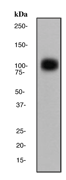
A. Western blot analysis on human cerebellum lysate using anti-GABA(B) R2 RabMAb (Cat. #AJ1310a), dilution 1:500.Application
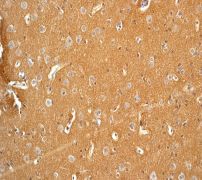
B. Immunohistochemical analysis of paraffin-embedded human brain using anti-GABA RabMAb (Cat. #AJ1310a).| Product Name | GABA(B) R2 Antibody |
|---|---|
| Antibody Type | Primary Antibodies |
| Clonality | Monoclonal |
|---|---|
| Clone Number | EP2411Y |
| Host Species | Rabbit |
| Tested Applications | WBIHC |
| WB:1:1000 IHC |
|
| Species Reactivity | Human |
| Concentration | 1mg/ml |
| Gene Synonyms | GPR51, GPRC3B |
|---|---|
| Molecular Weight(MW) | 105821 Da |
| Function | Receptor for GABA. The activity of this receptor is mediated by G-proteins that inhibit adenylyl cyclase activity, stimulates phospholipase A2, activates potassium channels, inactivates voltage-dependent calcium-channels and modulates inositol phospholipids hydrolysis. Plays a critical role in the fine-tuning of inhibitory synaptic transmission. Pre-synaptic GABA-B-R inhibit neurotransmitter release by down-regulating high- voltage activated calcium channels, whereas postsynaptic GABA-B-R decrease neuronal excitability by activating a prominent inwardly rectifying potassium (Kir) conductance that underlies the late inhibitory postsynaptic potentials. Not only implicated in synaptic inhibition but also in hippocampal long-term potentiation, slow wave sleep, muscle relaxation and antinociception |
| Tissue Specificity | Highly expressed in brain, especially in cerebral cortex, thalamus, hippocampus, frontal, occipital and temporal lobe, occipital pole and cerebellum, followed by corpus callosum, caudate nucleus, spinal cord, amygdala and medulla Weakly expressed in heart, testis and skeletal muscle |
| Cellular Localization | Cell membrane; Multi-pass membrane protein. Cell junction, synapse, postsynaptic cell membrane; Multi-pass membrane protein. Note=Moreover coexpression of GABA-B-R1 and GABA-B-R2 appears to be a prerequisite for maturation and transport of GABA-B-R1 to the plasma membrane |
| Entrez Gene | 9568 |
|---|
Application
A. Western blot analysis on human cerebellum lysate using anti-GABA(B) R2 RabMAb (Cat. #AJ1310a), dilution 1:500.
Application
B. Immunohistochemical analysis of paraffin-embedded human brain using anti-GABA RabMAb (Cat. #AJ1310a).| Application Notes | WB:1:1000 IHC |
|---|
| Form | Liquid |
|---|---|
| Storage Instructions | For short-term storage, store at 4° C. For long-term storage, aliquot and store at -20ºC or below. Avoid multiple freeze-thaw cycles. |
| Storage Buffer | 50 mM Tris-Glycine (pH 7.4), 0.15 M NaCl, 40% Glycerol, 0.01% sodium azide and 0.05% BSA. |


