Application
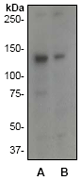
A. Western blot analysis of anti-Histone Deacetylase 4 (C-term) RabMAb (Cat. #AJ1349a), 1:500 dilution. A: Jurkat B: K562| Product Name | Histone Deacetylase 4 Antibody (C-term) |
|---|---|
| Antibody Type | Primary Antibodies |
| Clonality | Monoclonal |
|---|---|
| Clone Number | Y417 |
| Host Species | Rabbit |
| Tested Applications | WB |
| WB:1:500 |
|
| Species Reactivity | Human |
| Concentration | 1mg/ml |
| Gene Synonyms | KIAA0288 |
|---|---|
| Alternative Names | HDAC4 KIAA0288 Histone deacetylase 4 |
| Molecular Weight(MW) | 119040 Da |
| Function | Responsible for the deacetylation of lysine residues on the N-terminal part of the core histones (H2A, H2B, H3 and H4) Histone deacetylation gives a tag for epigenetic repression and plays an important role in transcriptional regulation, cell cycle progression and developmental events. Histone deacetylases act via the formation of large multiprotein complexes. Involved in muscle maturation via its interaction with the myocyte enhancer factors such as MEF2A, MEF2C and MEF2D |
| Tissue Specificity | Ubiquitous. |
| Cellular Localization | Nucleus. Cytoplasm. Note=Shuttles between the nucleus and the cytoplasm. Upon muscle cells differentiation, it accumulates in the nuclei of myotubes, suggesting a positive role of nuclear HDAC4 in muscle differentiation. The export to cytoplasm depends on the interaction with a 14-3-3 chaperone protein and is due to its phosphorylation at Ser-246, Ser-467 and Ser-632 by CaMK4 and SIK1. The nuclear localization probably depends on sumoylation |
| Entrez Gene | 9759 |
|---|
Application
A. Western blot analysis of anti-Histone Deacetylase 4 (C-term) RabMAb (Cat. #AJ1349a), 1:500 dilution. A: Jurkat B: K562| Application Notes | WB:1:500 |
|---|
| Form | Liquid |
|---|---|
| Storage Instructions | For short-term storage, store at 4° C. For long-term storage, aliquot and store at -20ºC or below. Avoid multiple freeze-thaw cycles. |
| Storage Buffer | 50 mM Tris-Glycine (pH 7.4), 0.15 M NaCl, 40% Glycerol, 0.01% sodium azide and 0.05% BSA. |


