Application
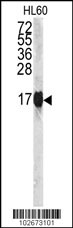
Western blot analysis of Histone H3 (N-term) in HL60 cell line lysates (35ug/lane). Histone H3 (arrow) was detected using the purified Pab.| Product Name | Histone H3 Antibody (S10) |
|---|---|
| Antibody Type | Primary Antibodies |
| Clonality | Polyclonal |
|---|---|
| Isotype | Ig |
| Host Species | Rabbit |
| Tested Applications | WB |
| WB:1:50~100 |
|
| Species Reactivity | Human |
| Concentration | 1mg/ml |
| Gene Synonyms | H3.3A, H3F3 |
|---|---|
| Alternative Names | H3F3A H3.3A H3F3 Histone H3.3 |
| Molecular Weight(MW) | 15328 Da |
| Function | Variant histone H3 which replaces conventional H3 in a wide range of nucleosomes in active genes. Constitutes the predominant form of histone H3 in non-dividing cells and is incorporated into chromatin independently of DNA synthesis Deposited at sites of nucleosomal displacement throughout transcribed genes, suggesting that it represents an epigenetic imprint of transcriptionally active chromatin. Nucleosomes wrap and compact DNA into chromatin, limiting DNA accessibility to the cellular machineries which require DNA as a template. Histones thereby play a central role in transcription regulation, DNA repair, DNA replication and chromosomal stability. DNA accessibility is regulated via a complex set of post-translational modifications of histones, also called histone code, and nucleosome remodeling |
| Tissue Specificity | This Histone H3 antibody is generated from rabbits immunized with a KLH conjugated synthetic peptide corresponding to amino acid residues surrounding S10 of human Histone H3. |
| Cellular Localization | Nucleus. Chromosome. |
| Entrez Gene | 3021 |
|---|
Application
Western blot analysis of Histone H3 (N-term) in HL60 cell line lysates (35ug/lane). Histone H3 (arrow) was detected using the purified Pab.| Application Notes | WB:1:50~100 |
|---|
| Form | Liquid |
|---|---|
| Storage Instructions | For short-term storage, store at 4° C. For long-term storage, aliquot and store at -20ºC or below. Avoid multiple freeze-thaw cycles. |
| Storage Buffer | Purified polyclonal antibody supplied in PBS with 0.09% (W/V) sodium azide. This antibody is purified through a protein A column, followed by peptide affinity purification. |


