Application
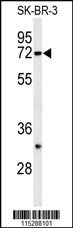
Western blot analysis of HRD1 Antibody (N-term) in SK-BR-3 cell line lysates (35ug/lane). HRD1 (arrow) was detected using the purified Pab.| Product Name | HRD1 Antibody (N-term) |
|---|---|
| Antibody Type | Primary Antibodies |
| Antigen Alias | SYVN1; HRD1; KIAA1810; E3 ubiquitin-protein ligase synoviolin; Synovial apoptosis inhibitor 1 |
| Clonality | Polyclonal |
|---|---|
| Isotype | Ig |
| Host Species | Rabbit |
| Tested Applications | WB |
| WB:1:50~100 |
|
| Species Reactivity | Human |
| Concentration | 1mg/ml |
| Gene Synonyms | HRD1 KIAA1810 |
|---|---|
| Alternative Names | SYVN1 HRD1 KIAA1810 E3 ubiquitin-protein ligase synoviolin Synovial apoptosis inhibitor 1 |
| Molecular Weight(MW) | 67685 Da |
| Function | Acts as an E3 ubiquitin-protein ligase which accepts ubiquitin specifically from endoplasmic reticulum-associated UBC7 E2 ligase and transfers it to substrates, promoting their degradation. Component of the endoplasmic reticulum quality control (ERQC) system also called ER-associated degradation (ERAD) involved in ubiquitin-dependent degradation of misfolded endoplasmic reticulum proteins. Also promotes the degradation of normal but naturally short-lived proteins such as SGK. Protects cells from ER stress-induced apoptosis. Protects neurons from apoptosis induced by polyglutamine-expanded huntingtin (HTT) or unfolded GPR37 by promoting their degradation. Sequesters p53/TP53 in the cytoplasm and promotes its degradation, thereby negatively regulating its biological function in transcription, cell cycle regulation and apoptosis |
| Tissue Specificity | Ubiquitously expressed, with highest levels in liver and kidney (at protein level). Up-regulated in synovial tissues from patients with rheumatoid arthritis (at protein level) |
| Cellular Localization | Endoplasmic reticulum membrane; Multi-pass membrane protein |
| Entrez Gene | 84447 |
|---|
Application
Western blot analysis of HRD1 Antibody (N-term) in SK-BR-3 cell line lysates (35ug/lane). HRD1 (arrow) was detected using the purified Pab.| Application Notes | WB:1:50~100 |
|---|
| Form | Liquid |
|---|---|
| Storage Instructions | For short-term storage, store at 4° C. For long-term storage, aliquot and store at -20ºC or below. Avoid multiple freeze-thaw cycles. |
| Storage Buffer | Purified polyclonal antibody supplied in PBS with 0.09% (W/V) sodium azide. This antibody is prepared by Saturated Ammonium Sulfate (SAS) precipitation followed by dialysis against PBS. |


