Application
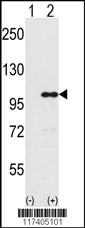
Western blot analysis of INPP5D (arrow) using rabbit polyclonal INPP5D Antibody (Center) .293 cell lysates (2 ug/lane) either nontransfected (Lane 1) or transiently transfected with the INPP5D gene (Lane 2) (Origene Technologies).| Product Name | INPP5D Antibody (Center) |
|---|---|
| Antibody Type | Primary Antibodies |
| Antigen Alias | INPP5D; SHIP; SHIP1; Phosphatidylinositol 3, 4, 5-trisphosphate 5-phosphatase 1; Inositol polyphosphate-5-phosphatase of 145 kDa; SH2 domain-containing inositol 5'-phosphatase 1; p150Ship |
| Clonality | Polyclonal |
|---|---|
| Isotype | Ig |
| Host Species | Rabbit |
| Tested Applications | WB |
| WB:1:50~100 |
|
| Species Reactivity | Human |
| Concentration | 1mg/ml |
| Gene Synonyms | SHIP SHIP1 |
|---|---|
| Alternative Names | INPP5D SHIP SHIP1 Phosphatidylinositol 3 4 5-trisphosphate 5-phosphatase 1 Inositol polyphosphate-5-phosphatase of 145 kDa SH2 domain-containing inositol 5'-phosphatase 1 p150Ship |
| Molecular Weight(MW) | 133292 Da |
| Function | Phosphatidylinositol (PtdIns) phosphatase that specifically hydrolyzes the 5-phosphate of phosphatidylinositol- 3,4,5-trisphosphate (PtdIns(3,4,5)P3) to produce PtdIns(3,4)P2, thereby negatively regulating the PI3K (phosphoinositide 3-kinase) pathways. Acts as a negative regulator of B-cell antigen receptor signaling. Mediates signaling from the FC-gamma-RIIB receptor (FCGR2B), playing a central role in terminating signal transduction from activating immune/hematopoietic cell receptor systems. Acts as a negative regulator of myeloid cell proliferation/survival and chemotaxis, mast cell degranulation, immune cells homeostasis, integrin alpha-IIb/beta-3 signaling in platelets and JNK signaling in B-cells. Regulates proliferation of osteoclast precursors, macrophage programming, phagocytosis and activation and is required for endotoxin tolerance. Involved in the control of cell-cell junctions, CD32a signaling in neutrophils and modulation of EGF-induced phospholipase C activity. Key regulator of neutrophil migration, by governing the formation of the leading edge and polarization required for chemotaxis Modulates FCGR3/CD16-mediated cytotoxicity in NK cells. Mediates the activin/TGF-beta-induced apoptosis through its Smad-dependent expression. May also hydrolyze PtdIns(1,3,4,5)P4, and could thus affect the levels of the higher inositol polyphosphates like InsP6 |
| Tissue Specificity | Specifically expressed in immune and hematopoietic cells. Expressed in bone marrow and blood cells Levels vary considerably within this compartment. Present in at least 74% of immature CD34+ cells, whereas within the more mature population of CD33+ cells, it is present in only 10% of cells Present in the majority of T-cells, while it is present in a minority of B-cells (at protein level) |
| Cellular Localization | Cytoplasm. Membrane; Peripheral membrane protein. Note=Translocates to the plasma membrane when activated, translocation is probably due to different mechanisms depending on the stimulus and cell type. Partly translocated via its SH2 domain which mediates interaction with tyrosine phosphorylated receptors such as the FC-gamma-RIIB receptor (FCGR2B) or CD16/FCGR3 Tyrosine phosphorylation may also participate in membrane localization (By similarity) |
| Entrez Gene | 3635 |
|---|
Application
Western blot analysis of INPP5D (arrow) using rabbit polyclonal INPP5D Antibody (Center) .293 cell lysates (2 ug/lane) either nontransfected (Lane 1) or transiently transfected with the INPP5D gene (Lane 2) (Origene Technologies).| Application Notes | WB:1:50~100 |
|---|
| Form | Liquid |
|---|---|
| Storage Instructions | For short-term storage, store at 4° C. For long-term storage, aliquot and store at -20ºC or below. Avoid multiple freeze-thaw cycles. |
| Storage Buffer | Purified polyclonal antibody supplied in PBS with 0.09% (W/V) sodium azide. This antibody is prepared by Saturated Ammonium Sulfate (SAS) precipitation followed by dialysis against PBS. |


