Application
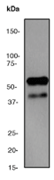
A. Western blot analysis on HeLa cell lysate using anti-JNK2 RabMAb (Cat. #AJ1425a), dilution 1:50,000.Application
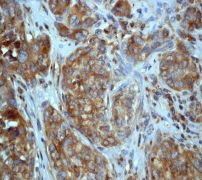
B. Immunohistochemical staining of paraffin-embedded human breast carcinoma using anti-JNK2 RabMAb (Cat. #AJ1425a).| Product Name | JNK2 Antibody |
|---|---|
| Antibody Type | Primary Antibodies |
| Antigen Alias | MAPK9, JNK2, PRKM9, Mitogen-activated protein kinase 9, Stress-activated protein kinase JNK2;c-Jun N-terminal kinase 2;JNK-55 |
| Clonality | Monoclonal |
|---|---|
| Clone Number | EP1595Y |
| Host Species | Rabbit |
| Tested Applications | WBIHC |
| WB:1:500 IHC |
|
| Species Reactivity | Human |
| Concentration | 1mg/ml |
| Gene Synonyms | JNK2 PRKM9 SAPK1A |
|---|---|
| Alternative Names | MAPK9 JNK2 PRKM9 Mitogen-activated protein kinase 9 Stress-activated protein kinase JNK2 c-Jun N-terminal kinase 2 JNK-55 |
| Molecular Weight(MW) | 48139 Da |
| Function | Serine/threonine-protein kinase involved in various processes such as cell proliferation, differentiation, migration, transformation and programmed cell death. Extracellular stimuli such as proinflammatory cytokines or physical stress stimulate the stress-activated protein kinase/c-Jun N-terminal kinase (SAP/JNK) signaling pathway. In this cascade, two dual specificity kinases MAP2K4/MKK4 and MAP2K7/MKK7 phosphorylate and activate MAPK9/JNK2 In turn, MAPK9/JNK2 phosphorylates a number of transcription factors, primarily components of AP-1 such as JUN and ATF2 and thus regulates AP-1 transcriptional activity. In response to oxidative or ribotoxic stresses, inhibits rRNA synthesis by phosphorylating and inactivating the RNA polymerase 1-specific transcription initiation factor RRN3. Promotes stressed cell apoptosis by phosphorylating key regulatory factors including TP53 and YAP1. In T-cells, MAPK8 and MAPK9 are required for polarized differentiation of T-helper cells into Th1 cells. Upon T-cell receptor (TCR) stimulation, is activated by CARMA1, BCL10, MAP2K7 and MAP3K7/TAK1 to regulate JUN protein levels. Plays an important role in the osmotic stress-induced epithelial tight-junctions disruption. When activated, promotes beta-catenin/CTNNB1 degradation and inhibits the canonical Wnt signaling pathway Participates also in neurite growth in spiral ganglion neurons |
| Tissue Specificity | A synthetic peptide corresponding to residues near the C-terminus of human JNK2 was used as an immunogen. |
| Cellular Localization | Cytoplasm. Nucleus. |
| Entrez Gene | 5601 |
|---|
Application
A. Western blot analysis on HeLa cell lysate using anti-JNK2 RabMAb (Cat. #AJ1425a), dilution 1:50,000.
Application
B. Immunohistochemical staining of paraffin-embedded human breast carcinoma using anti-JNK2 RabMAb (Cat. #AJ1425a).| Application Notes | WB:1:500 IHC |
|---|
| Form | Liquid |
|---|---|
| Storage Instructions | For short-term storage, store at 4° C. For long-term storage, aliquot and store at -20ºC or below. Avoid multiple freeze-thaw cycles. |
| Storage Buffer | 50 mM Tris-Glycine (pH 7.4), 0.15 M NaCl, 40% Glycerol, 0.01% sodium azide and 0.05% BSA. |


