Application
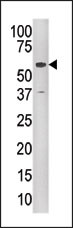
Western blot analysis of anti-HTATIP Pab in CEM cell line tissue lysate (35ug/lane).HTATIP(arrow) was detected using the purified Pab (1:60 dilution).| Product Name | KAT5 / Tip60/HTATIP Antibody (C-term) |
|---|---|
| Antibody Type | Primary Antibodies |
| Antigen Alias | KAT5; HTATIP; TIP60; Histone acetyltransferase KAT5; 60 kDa Tat-interactive protein; Histone acetyltransferase HTATIP; Lysine acetyltransferase 5; cPLA(2)-interacting protein |
| Clonality | Polyclonal |
|---|---|
| Isotype | Ig |
| Host Species | Rabbit |
| Tested Applications | WB |
| WB:1:100~500 |
|
| Species Reactivity | Human |
| Concentration | 1mg/ml |
| Gene Synonyms | HTATIP TIP60 |
|---|---|
| Alternative Names | KAT5 HTATIP TIP60 Histone acetyltransferase KAT5 60 kDa Tat-interactive protein Histone acetyltransferase HTATIP Lysine acetyltransferase 5 cPLA(2)-interacting protein |
| Molecular Weight(MW) | 58582 Da |
| Function | Catalytic subunit of the NuA4 histone acetyltransferase complex which is involved in transcriptional activation of select genes principally by acetylation of nucleosomal histones H4 and H2A. This modification may both alter nucleosome-DNA interactions and promote interaction of the modified histones with other proteins which positively regulate transcription. This complex may be required for the activation of transcriptional programs associated with oncogene and proto-oncogene mediated growth induction, tumor suppressor mediated growth arrest and replicative senescence, apoptosis, and DNA repair. NuA4 may also play a direct role in DNA repair when recruited to sites of DNA damage. Directly acetylates and activates ATM. In case of HIV-1 infection, interaction with the viral Tat protein leads to KAT5 polyubiquitination and targets it to degradation |
| Tissue Specificity | This KAT5 / Tip60/HTATIP antibody is generated from rabbits immunized with a KLH conjugated synthetic peptide between 476~505 amino acids from the C-terminal region of human HTATIP. |
| Cellular Localization | Nucleus, nucleolus. Cytoplasm, perinuclear region. Note=Upon stimulation with EDN1, it is exported from the nucleus to the perinuclear region and UV irradiation induces translocation into punctuate subnuclear structures named nuclear bodies |
| Entrez Gene | 10524 |
|---|
Application
Western blot analysis of anti-HTATIP Pab in CEM cell line tissue lysate (35ug/lane).HTATIP(arrow) was detected using the purified Pab (1:60 dilution).| Application Notes | WB:1:100~500 |
|---|
| Form | Liquid |
|---|---|
| Storage Instructions | For short-term storage, store at 4° C. For long-term storage, aliquot and store at -20ºC or below. Avoid multiple freeze-thaw cycles. |
| Storage Buffer | Purified polyclonal antibody supplied in PBS with 0.09% (W/V) sodium azide. This antibody is purified through a protein G column, eluted with high and low pH buffers and neutralized immediately, followed by dialysis against PBS. |


