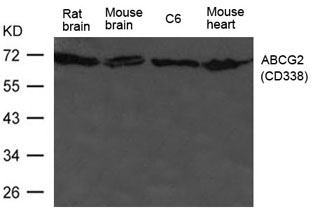
Application
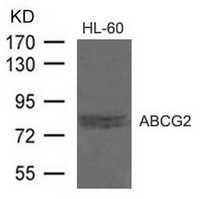
Western blot analysis of extract from HL-60 cells using ABCG2(CD338) AntibodyApplication
Western blot analysis of extract from HL-60 cells using ABCG2 (CD338) Antibody| Product Name | ABCG2 antibody |
|---|---|
| Antibody Type | Primary Antibodies |
| Product description | Rabbit Polyclonal antibody to ABCG2Xenobiotic transporter that may play an important role in the exclusion of xenobiotics from the brain. May be involved in brain-to-blood efflux. Appears to play a major role in the multidrug resistance phenotype of several cancer cell lines. When overexpressed, the transfected cells become resistant to mitoxantrone, daunorubicin and doxorubicin, display diminished intracellular accumulation of daunorubicin, and manifest an ATP-dependent increase in the efflux of rhodamine 123. |
| Immunogen | Peptide sequence around aa.160~164( R-I-N-R-V) derived from Human ABCG2(CD338). |
| Clonality | Polyclonal |
|---|---|
| Host Species | Rabbit |
| Tested Applications | WB |
| Suggested starting dilutions are as follows. WB: 1:500. Not yet tested in other applications. Optimal working dilutions should be determined experimentally by the end user.: |
|
| Species Reactivity | HumanMouseRat |
| Concentration | 1mg/ml (Please refer to the vial label for the specific concentration) |
| Purification | Affinity purified |
| Gene Synonyms | ABC15 ABCP BCRP BCRP1 BMDP CD338 CDw338 EST157481 MGC102821 MRX MXR MXR1 ABCG2 ATP-binding cassette sub-family G member 2 mitoxantrone resistance-associated protein breast cancer resistance protein ATP-binding cassette transporter G2 place |
|---|---|
| Target | ABCG2 |
| Molecular Weight(MW) | 65-80 (note) |
Application
Western blot analysis of extract from HL-60 cells using ABCG2(CD338) Antibody
Application
Western blot analysis of extract from HL-60 cells using ABCG2 (CD338) Antibody| Application Notes | Suggested starting dilutions are as follows. WB: 1:500. Not yet tested in other applications. Optimal working dilutions should be determined experimentally by the end user.: |
|---|
| Form | Liquid |
|---|---|
| Storage Instructions | Keep as concentrated solution. Aliquot and store at -20ºC or below. Avoid multiple freeze-thaw cycles. |
| Storage Buffer | saline (without Mg2+ and Ca2+), pH 7.4, 150mM NaCl, 0.02% sodium azide and 50% glycerol. |


