Application
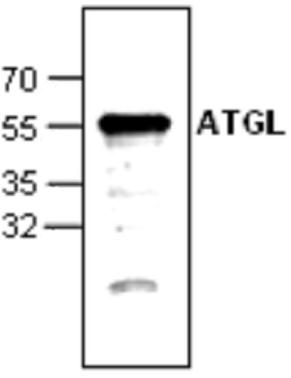
Western blot analysis of ATGL expression in rat kidney tissue lysate.| Product Name | ATGL antibody |
|---|---|
| Antibody Type | Primary Antibodies |
| Product description | Rabbit polyclonal antibody to ATGLTriglycerides form an important energy store in many living organisms. Adipose tissue serves as the primary storage depot for triglycerides in mammals. Lipolytic enzymes mobilize triglycerides during periods of starvation to provide organisms with necessary energy. Hormone-sensitive lipase (HSL), the first identified lipolytic enzyme, hydrolyzes triglycerides in mammalian adipose tissues. Additional lipolytic enzymes, including adipose triglyceride lipase (ATGL), have also been discovered. The primary function of ATGL is to catalyze the hydrolysis of the first ester bond of lipid molecules. This enzyme may provide diglyceride substrates for HSL hydrolysis. ATGL is abundantly expressed in murine white and brown adipose tissue, and is highly substrate specific. ATGL was independently identified as desnutrin and the TG-hydrolace inducible phospholipase-A2-z. |
| Clonality | Polyclonal |
|---|---|
| Isotype | IgG |
| Host Species | Rabbit |
| Tested Applications | IPWB |
| Western blotting (0.5-4 µg/ml) and immunoprecipitation. recognizes 54 kDa ATGL in samples from human, mouse and rat origins. However, the optimal concentrations should be determined individually.: |
|
| Species Reactivity | HumanMouseRat |
| Concentration | 0.5mg/ml |
| Purification | Affinity purified |
| Gene Synonyms | Transportsecretion protein2 Transport-secretion protein 2 Desnutrin TTS2 Patatinlike phospholipase domaincontaining protein2 Patatin-like phospholipase domain-containing protein 2 Transportsecretion protein 2 Adipose Triglyceride Lipase PNPLA2 Pat |
|---|---|
| Target | ATGL |
| Tissue Specificity | This antibody is specific for ATGL. |
Application
Western blot analysis of ATGL expression in rat kidney tissue lysate.| Application Notes | Western blotting (0.5-4 µg/ml) and immunoprecipitation. recognizes 54 kDa ATGL in samples from human, mouse and rat origins. However, the optimal concentrations should be determined individually.: |
|---|
| Form | Liquid |
|---|---|
| Storage Instructions | The antibody solution should be gently mixed before use. Stored at -20 °C for future use. |
| Storage Buffer | PBS (pH 7.2) containing 30% glycerol, 0.5% BSA, and 0.01% thimerosal |


