Application
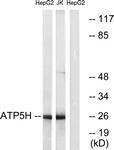
Western blot analysis of extracts from HepG2/Jurkat cells, using ATP5H Antibody. The lane on the right is treated with the synthesized peptide.| Product Name | ATP5H antibody |
|---|---|
| Antibody Type | Primary Antibodies |
| Product description | Rabbit polyclonal antibody to ATP5HMitochondrial membrane ATP synthase (F(1)F(0) ATP synthase or Complex V) produces ATP from ADP in the presence of a proton gradient across the membrane which is generated by electron transport complexes of the respiratory chain. F-type ATPases consist of two structural domains, F(1) - containing the extramembraneous catalytic core, and F(0) - containing the membrane proton channel, linked together by a central stalk and a peripheral stalk. During catalysis, ATP synthesis in the catalytic domain of F(1) is coupled via a rotary mechanism of the central stalk subunits to proton translocation. Part of the complex F(0) domain and the peripheric stalk, which acts as a stator to hold the catalytic alpha(3)beta(3) subcomplex and subunit a/ATP6 static relative to the rotary elements. |
| Immunogen | The antiserum was produced against synthesized peptide derived from human ATP5H. |
| Clonality | Polyclonal |
|---|---|
| Host Species | Rabbit |
| Tested Applications | ELISAWB |
| ELISA: 1:20000Optimal dilutions should be determined experimentally by the end user.: |
|
| Species Reactivity | HumanMouseRat |
| Concentration | 1mg/ml |
| Purification | Affinity purified |
| Gene Synonyms | ATP5H ATP synthase subunit d mitochondrial |
|---|---|
| Target | ATP5H |
| Molecular Weight(MW) | 18 kDa (note) |
| Tissue Specificity | ATP5H Antibody detects endogenous levels of total ATP5H protein. |
Application
Western blot analysis of extracts from HepG2/Jurkat cells, using ATP5H Antibody. The lane on the right is treated with the synthesized peptide.| Application Notes | ELISA: 1:20000Optimal dilutions should be determined experimentally by the end user.: |
|---|
| Form | Liquid |
|---|---|
| Storage Instructions | Store at -20 degrees Celcius. Product is stable for at least 1 year. |
| Storage Buffer | Phosphate buffered saline (without Mg2+ and Ca2+), pH 7.4, 150mM NaCl, 0.02% sodium azide and 50% glycerol. |


