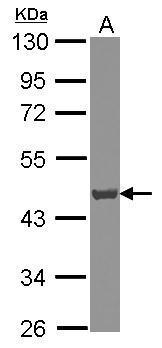
Application
Sample (30 ug of whole cell lysate) A: IMR32 10% SDS PAGE diluted at 1:500| Product Name | ATP6V0D1 antibody |
|---|---|
| Antibody Type | Primary Antibodies |
| Product description | Rabbit Polyclonal antibody to ATP6V0D1 (ATPase, H+ transporting, lysosomal 38kDa, V0 subunit d1)This gene encodes a component of vacuolar ATPase (V-ATPase), a multisubunit enzyme that mediates acidification of eukaryotic intracellular organelles. V-ATPase dependent organelle acidification is necessary for such intracellular processes as protein sorting, zymogen activation, receptor-mediated endocytosis, and synaptic vesicle proton gradient generation. V-ATPase is composed of a cytosolic V1 domain and a transmembrane V0 domain. The V1 domain consists of three A and three B subunits, two G subunits plus the C, D, E, F, and H subunits. The V1 domain contains the ATP catalytic site. The V0 domain consists of five different subunits: a, c, c', c'', and d. Additional isoforms of many of the V1 and V0 subunit proteins are encoded by multiple genes or alternatively spliced transcript variants. This encoded protein is known as the D subunit and is found ubiquitously. [provided by RefSeq] |
| Immunogen | Recombinant protein encompassing a sequence within the center region of human ATP6V0D1. The exact sequence is proprietary. |
| Clonality | Polyclonal |
|---|---|
| Isotype | IgG |
| Host Species | Rabbit |
| Tested Applications | WB |
| *Optimal dilutions/concentrations should be determined by the researcher.
: |
|
| Species Reactivity | Human |
| Predicted Reactivity | Mouse, Rat, Zebrafish, Xenopus laevis, Chicken, BovineMouse (99%), Rat (99%), Zebrafish (94%), Xenopus laevis (95%), Chicken (98%), Bovine (100%) |
| Concentration | 1mg/ml (Please refer to the vial label for the specific concentration) |
| Purification | Affinity purified |
| Gene Synonyms | ATP6D antibody ATP6DV antibody FLJ43534 antibody P39 antibody VATX antibody VMA6 antibody VPATPD antibody ATP6V0D1 antibody "ATPase H+ transporting lysosomal (vacuolar proton pump) member D antibody" "H(+)-transporting two-sector ATPase subuni |
|---|---|
| Molecular Weight(MW) | 40 kDa (note) (2) |
Application
Sample (30 ug of whole cell lysate) A: IMR32 10% SDS PAGE diluted at 1:500| Positive Control | NT2D1 , IMR32 , U87-MG |
|---|---|
| Application Notes | *Optimal dilutions/concentrations should be determined by the researcher.
: |
| Form | Liquid |
|---|---|
| Storage Instructions | Keep as concentrated solution. Aliquot and store at -20ºC or below. Avoid multiple freeze-thaw cycles. |
| Storage Buffer | 1XPBS, 1% BSA, 20% Glycerol (pH7). 0.01% Thimerosal was added as a preservative. |


