Application
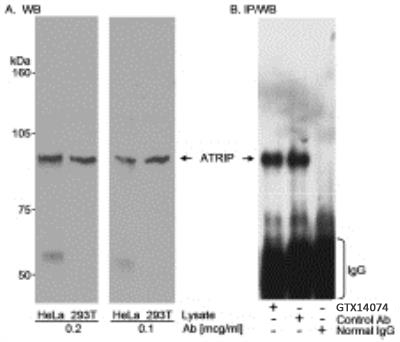
Immunoprecipitation: ATRIP Antibody - Whole cell lysate from HeLa and 293-T cells. ATRIP was also IPed using a control antibody generated to recombinant human ATRIP. IPed ATRIP was detected using the antibody to the recombinant protein.| Product Name | ATRIP antibody |
|---|---|
| Antibody Type | Primary Antibodies |
| Product description | Rabbit polyclonal to ATRIPATR- interacting protein (ATRIP) is an essential component of the DNA damage checkpoint pathway. ATRIP, phosphorylated by ataxia telangiectasia mutated and Rad3 kinase (ATR), regulates ATR expression, signifying their mutual dependence. The ATR-ATRIP protein kinase complex is essential for the cellular response to replication stress and DNA damage. It has been shown, in vitro, that replication protein A (RPA) stimulates the binding of ATRIP to single-stranded DNA. This enables the ATR-ATRIP complex to associate with DNA and stimulates phosphorylation of the RAD17 protein that is bound to DNA. ATR/ATRIP exist as a large molecular weight complex that can bind single-stranded DNA cellulose in vitro. Neither ATR nor ATRIP are able to bind DNA individually, nor do they bind DNA in a cooperative manner. |
| Immunogen | Synthetic peptide derived from a sequence between amino acids 500-550 of the human ATRIP protein (aka TREX1) |
| Clonality | Polyclonal |
|---|---|
| Isotype | IgG |
| Host Species | Rabbit |
| Tested Applications | IPWB |
| For IP: Use 3-8μg/ml of lysate. For WB: Use at a dilution of 1:5,000-1:15,000. Not yet tested in other applications. Optimal dilutions/concentrations should be determined by the researcher.: |
|
| Species Reactivity | Human |
| Concentration | 1mg/ml (Please refer to the vial label for the specific concentration) |
| Purification | Protein G |
| Gene Synonyms | 606605 ATRIP 11277 DRN3 FLJ12343 TREX1 DKFZp434J0310 Q9NSU2 |
|---|---|
| Target | ATRIP |
| Tissue Specificity | Reactivity with intraprimates is unlikely owing to sequence divergence at the site to which the immunogen epitope maps. |
Application
Immunoprecipitation: ATRIP Antibody - Whole cell lysate from HeLa and 293-T cells. ATRIP was also IPed using a control antibody generated to recombinant human ATRIP. IPed ATRIP was detected using the antibody to the recombinant protein.| Positive Control | HeLa Whole Cell Lysate |
|---|---|
| Application Notes | For IP: Use 3-8μg/ml of lysate. For WB: Use at a dilution of 1:5,000-1:15,000. Not yet tested in other applications. Optimal dilutions/concentrations should be determined by the researcher.: |
| Form | Liquid |
|---|---|
| Storage Instructions | Keep as concentrated solution, aliquot and store at 4°C. Do not freeze. |
| Storage Buffer | Phosphate-buffered saline and 50% Glycerol containing 0.1% sodium azide |


