Application
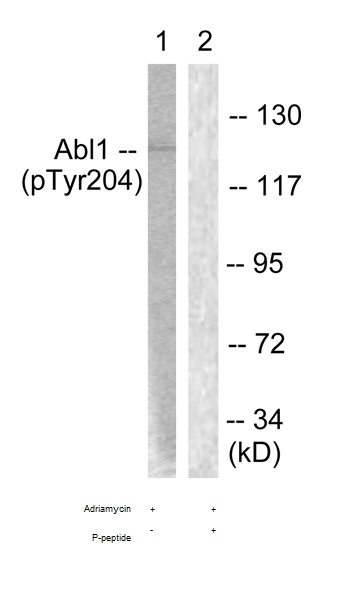
Western blot analysis of extracts from COS7 cells, Adriamycin (0.5μg/ml, 24 hours), using Abl (Phospho-Tyr204) antibody.| Product Name | c-Abl (phospho Tyr204) antibody |
|---|---|
| Antibody Type | Primary Antibodies |
| Product description | Rabbit polyclonal antibody to c-Abl (phospho Tyr204)The ABL1 protooncogene encodes a cytoplasmic and nuclear protein tyrosine kinase that has been implicated in processes of cell differentiation, cell division, cell adhesion, and stress response. Activity of c-Abl protein is negatively regulated by its SH3 domain, and deletion of the SH3 domain turns ABL1 into an oncogene. The t(9;22) translocation results in the head-to-tail fusion of the BCR (MIM:151410) and ABL1 genes present in many cases of chronic myelogeneous leukemia. The DNA-binding activity of the ubiquitously expressed ABL1 tyrosine kinase is regulated by CDC2-mediated phosphorylation, suggesting a cell cycle function for ABL1. The ABL1 gene is expressed as either a 6- or 7-kb mRNA transcript, with alternatively spliced first exons spliced to the common exons 2-11. [provided by RefSeq] |
| Modification | p-Tyr204 |
| Clonality | Polyclonal |
|---|---|
| Isotype | IgG |
| Host Species | Rabbit |
| Tested Applications | ELISAIHCWB |
| Suggested starting dilutions are as follows. WB: 1:500-1:1000,IHC: 1:50-1:100,ELISA: 1:4000. Not yet tested in other applications. Optimal working dilutions should be determined experimentally by the end user.: |
|
| Species Reactivity | HumanMouseRat |
| Concentration | 1mg/ml (Please refer to the vial label for the specific concentration) |
| Purification | Affinity purified |
| Gene Synonyms | ABL JTK7 c-ABL p150 v-abl |
|---|---|
| Target | c-Abl (phospho Tyr204) |
| Cellular Localization | Sequestered into the cytoplasm through interaction with 14-3-3 proteins. The myristoylated c-ABL protein is reported to be nuclear. |
Application
Western blot analysis of extracts from COS7 cells, Adriamycin (0.5μg/ml, 24 hours), using Abl (Phospho-Tyr204) antibody.| Application Notes | Suggested starting dilutions are as follows. WB: 1:500-1:1000,IHC: 1:50-1:100,ELISA: 1:4000. Not yet tested in other applications. Optimal working dilutions should be determined experimentally by the end user.: |
|---|
| Form | Liquid |
|---|---|
| Storage Instructions | Keep as concentrated solution. Aliquot and store at -20ºC or below. Avoid multiple freeze-thaw cycles. |
| Storage Buffer | PBS (without Mg2+and Ca2+), pH 7.4, 150mM NaCl,0.02% sodium azide and 50% glycerol. |


