Application
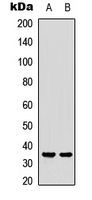
Western blot analysis of Caspase 3 (pS150) expression in HCT116 (A); Jurkat (B) whole cell lysates.Application
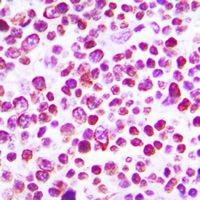
Immunohistochemical analysis of Caspase 3 (pS150) staining in human tonsil formalin fixed paraffin embedded tissue section. The section was pre-treated using heat mediated antigen retrieval with sodium citrate buffer (pH 6.0). The section was then incubated with the antibody at room temperature and detected using an HRP conjugated compact polymer system. DAB was used as the chromogen. The section was then counterstained with haematoxylin and mounted with DPX.| Product Name | Caspase 3 (phospho Ser150) antibody |
|---|---|
| Antibody Type | Primary Antibodies |
| Product description | Rabbit Polyclonal antibody to Caspase 3 (phospho Ser150)This gene encodes a protein which is a member of the cysteine-aspartic acid protease (caspase) family. Sequential activation of caspases plays a central role in the execution-phase of cell apoptosis. Caspases exist as inactive proenzymes which undergo proteolytic processing at conserved aspartic residues to produce two subunits, large and small, that dimerize to form the active enzyme. This protein cleaves and activates caspases 6, 7 and 9, and the protein itself is processed by caspases 8, 9 and 10. It is the predominant caspase involved in the cleavage of amyloid-beta 4A precursor protein, which is associated with neuronal death in Alzheimer's disease. Alternative splicing of this gene results in two transcript variants that encode the same protein. [provided by RefSeq, Jul 2008] |
| Immunogen | KLH-conjugated synthetic peptide encompassing a sequence within the center region of human Caspase 3. The exact sequence is proprietary. |
| Modification | p-Ser150 |
| Clonality | Polyclonal |
|---|---|
| Isotype | IgG |
| Host Species | Rabbit |
| Tested Applications | IHC-PWB |
| WB: 1:500 - 1:1000. IHC-P: 1:100 - 1:200: |
|
| Species Reactivity | Human |
| Concentration | 1mg/ml |
| Purification | Affinity purified |
| Gene Synonyms | CPP32B SCA-1 CPP32 CASP3 caspase 3 apoptosis-related cysteine peptidase |
|---|---|
| Target | Caspase 3 |
| Tissue Specificity | Recognizes endogenous levels of Caspase 3 (pS150) protein. |
Application
Western blot analysis of Caspase 3 (pS150) expression in HCT116 (A); Jurkat (B) whole cell lysates.
Application
Immunohistochemical analysis of Caspase 3 (pS150) staining in human tonsil formalin fixed paraffin embedded tissue section. The section was pre-treated using heat mediated antigen retrieval with sodium citrate buffer (pH 6.0). The section was then incubated with the antibody at room temperature and detected using an HRP conjugated compact polymer system. DAB was used as the chromogen. The section was then counterstained with haematoxylin and mounted with DPX.| Application Notes | WB: 1:500 - 1:1000. IHC-P: 1:100 - 1:200: |
|---|
| Form | Liquid |
|---|---|
| Storage Instructions | Shipped at 4 C. Upon delivery aliquot and store at -20 C for one year. Avoid freeze/thaw cycles. |
| Storage Buffer | Liquid in 0.42% Potassium phosphate, 0.87% Sodium chloride, pH 7.3, 30% glycerol, and 0.01% sodium azide. |


