Application
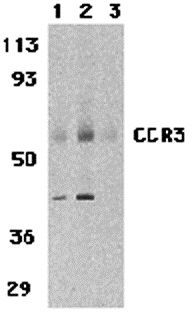
Western blot analysis of CCR3 in human spleen tissue lysates with CCR3 antibody at 1 (lane 1) and 2 ug/mL (lane 2), and 2 ug/mL in the presence of blocking peptide (lane 3).| Product Name | CCR3 antibody |
|---|---|
| Antibody Type | Primary Antibodies |
| Product description | Rabbit Polyclonal antibody to CCR3The protein encoded by this gene is a receptor for C-C type chemokines. It belongs to family 1 of the G protein-coupled receptors. This receptor binds and responds to a variety of chemokines, including eotaxin (CCL11), eotaxin-3 (CCL26), MCP-3 (CCL7), MCP-4 (CCL13), and RANTES (CCL5). It is highly expressed in eosinophils and basophils, and is also detected in TH1 and TH2 cells, as well as in airway epithelial cells. This receptor may contribute to the accumulation and activation of eosinophils and other inflammatory cells in the allergic airway. It is also known to be an entry co-receptor for HIV-1. This gene and seven other chemokine receptor genes form a chemokine receptor gene cluster on the chromosomal region 3p21. Alternatively spliced transcript variants have been described. [provided by RefSeq, Sep 2009] |
| Immunogen | CCR3 antibody was raised against a 14 amino acid synthetic peptide from near the amino terminus of human CCR3. |
| Clonality | Polyclonal |
|---|---|
| Isotype | IgG |
| Host Species | Rabbit |
| Tested Applications | ELISAWB |
| WB: 1 - 2 ug/mL: |
|
| Species Reactivity | Human |
| Concentration | 1mg/ml |
| Purification | Affinity purified |
| Gene Synonyms | chemokine (C-C motif) receptor 3 CKR3 CMKBR3 CC-CKR-3 CD193 |
|---|---|
| Target | CCR3 |
Application
Western blot analysis of CCR3 in human spleen tissue lysates with CCR3 antibody at 1 (lane 1) and 2 ug/mL (lane 2), and 2 ug/mL in the presence of blocking peptide (lane 3).| Application Notes | WB: 1 - 2 ug/mL: |
|---|
| Form | Liquid |
|---|---|
| Storage Instructions | Be stored at 4oC for three months and -20oC, stable for up to one year. As with all antibodies care should be taken to avoid repeated freeze thaw cycles. Antibodies should not be exposed to prolonged high temperatures. |
| Storage Buffer | PBS containing 0.02% sodium azide. |


