Application
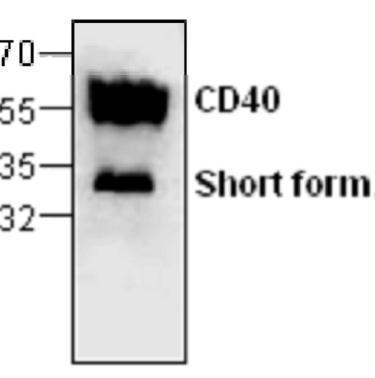
Western blot analysis of CD40 expression in rat kidney tissue lysate.| Product Name | CD40 antibody |
|---|---|
| Antibody Type | Primary Antibodies |
| Product description | Rabbit polyclonal antibody to CD40CD40 is a type I membrane protein found on the surface of B cells and primary carcinomas. It belongs to the TNF-R family. CD40 serves as the receptor for CD40 ligand (CD40L), a cytokine expressed on the cell surface of T cells. CD40 plays a critical role in B cell proliferation, antibody class switching, modulation of apoptosis in the germinal center through interaction with T cells expressing CD40L, and activation of CD4+ T cells. In non-hemopoitic cells such as epidermal basal cells, CD40 ligation serves as the signal for inhibition of cell growth and induction of differentiation. The cytoplasmic domain of CD40 interacts with TRAF6, a TNFR associated factor homolog that mediates signaling from CD40. Ligation of CD40 with its ligand preferentially induces stress-activated protein kinases in B lymphocytes. |
| Clonality | Polyclonal |
|---|---|
| Isotype | IgG |
| Host Species | Rabbit |
| Tested Applications | WB |
| Western blotting (0.5-4 µg/ml). However, the optimal conditions should be determined individually.: |
|
| Species Reactivity | HumanMouseMonkeyPigRat |
| Concentration | 0.2mg/ml |
| Purification | Affinity purified |
| Gene Synonyms | CD40 CDW40 TNFRSF5 p50 MGC9013 Bp50 |
|---|---|
| Target | CD40 |
| Tissue Specificity | This antibody is specific for CD40. |
Application
Western blot analysis of CD40 expression in rat kidney tissue lysate.| Application Notes | Western blotting (0.5-4 µg/ml). However, the optimal conditions should be determined individually.: |
|---|
| Form | Liquid |
|---|---|
| Storage Instructions | The antibody solution should be gently mixed before use. Stored at -20 °C for future use. |
| Storage Buffer | PBS (pH 7.2) containing 30% glycerol, 0.5% BSA, 0.01% thimerosal |


