Application
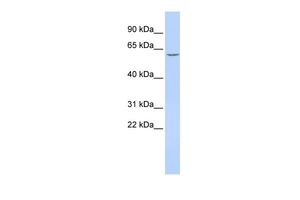
WB analysis of HepG2 cells using CES7 antibody at 0.2-1μg/ml.| Product Name | CES7 antibody, Internal |
|---|---|
| Antibody Type | Primary Antibodies |
| Product description | Rabbit Polyclonal antibody to CES7This gene encodes a member of the carboxylesterase large family. The family members are responsible for the hydrolysis or transesterification of various xenobiotics, such as cocaine and heroin, and endogenous substrates with ester, thioester, or amide bonds. They also participate in fatty acyl and cholesterol ester metabolism, and may play a role in the blood-brain barrier system. This gene, also called CES5, is predominantly expressed in peripheral tissues, including brain, kidney, lung and testis. It encodes a secreted enzyme. Because of high levels in the urine of male domestic cats, this enzyme is also called cauxin (carboxylesterase-like urinary excreted protein). The enzyme functions in regulating the production of a pheromone precursor and may contribute to lipid and cholesterol transfer processes within male reproductive fluids. Multiple transcript variants encoding different isoforms have been found for this gene. [provided by RefSeq, Jun 2010] |
| Immunogen | A synthetic peptide corresponding to an Internal region of Human CES7 |
| Clonality | Polyclonal |
|---|---|
| Isotype | IgG |
| Host Species | Rabbit |
| Tested Applications | WB |
| *Optimal dilutions/concentrations should be determined by the researcher.
: |
|
| Species Reactivity | Human |
| Predicted Reactivity | Human: 100%; Rat: 85% |
| Concentration | 1mg/ml |
| Purification | Affinity purified |
| Gene Synonyms | CES7 CES4C1 CAUXIN CES5A CES5 |
|---|---|
| Target | CES7 |
| Molecular Weight(MW) | 64 KDa (note) |
Application
WB analysis of HepG2 cells using CES7 antibody at 0.2-1μg/ml.| Positive Control | HepG2 |
|---|---|
| Application Notes | *Optimal dilutions/concentrations should be determined by the researcher.
: |
| Form | Liquid |
|---|---|
| Storage Instructions | Keep as concentrated solution. For short-term storage, store at 4ºC. For long-term storage, aliquot and store at -20ºC or below. Avoid multiple freeze-thaw cycles. |
| Storage Buffer | 1x PBS buffer with 0.09% (w/v) sodium azide and 2% sucrose. |


