Application
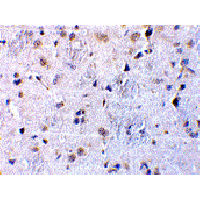
Immunohistochemical staining of rat brain tissue using CTRP7 antibody at 10 μg/mL.Application
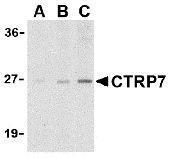
Western blot analysis of CTRP7 in 3T3 cell lysate with CTRP7 antibody at (A) 1, (B) 2, and (C) 4 ug/ml.| Product Name | CTRP7 antibody |
|---|---|
| Antibody Type | Primary Antibodies |
| Product description | Rabbit polyclonal antibody to CTRP7Adipose tissue of an organism plays a major role in regulating physiologic and pathologic processes such as metabolism and immunity by producing and secreting a variety of bioactive molecules termed adipokines (reviewed in 1). One highly conserved family of adipokines is adiponectin/ACRP30 and its structural and functional paralogs, the C1q/tumor necrosis factor-?-related proteins (CTRPs) 1-7 (2). Unlike adiponectin, which is expressed exclusively by differentiated adipocytes, the CTRPs are expressed in a wide variety of tissues (3). These proteins are thought to act mainly on liver and muscle tissue to control glucose and lipid metabolism. An analysis of the crystal structure of adiponectin revealed a structural and evolutionary link between TNF and C1q-containing proteins, suggesting that these proteins arose from a common ancestral innate immunity gene (4). Like the other members of the adiponectin and CTRP protein family, the mature CTRP7 is secreted and can be found in the organism’s circulatory system (1). |
| Immunogen | Human CTRP7 (N-Terminus) Peptide |
| Clonality | Polyclonal |
|---|---|
| Host Species | Rabbit |
| Tested Applications | ELISAICC/IFIHC-PWB |
| ICC/IF:1:200~1:500 IHC-P:1:50~1:200 WB:1:500~1:2000 Notes:Optimal dilutions/concentrations should be determined by the researcher. |
|
| Species Reactivity | HumanMouseRat |
| Concentration | 1mg/ml |
| Purification | Affinity purified |
| Gene Synonyms | CTRP7 |
|---|---|
| Target | CTRP7 |
| Tissue Specificity | This antibody is specific for CTRP7 N-Terminus |
Application
Immunohistochemical staining of rat brain tissue using CTRP7 antibody at 10 μg/mL.
Application
Western blot analysis of CTRP7 in 3T3 cell lysate with CTRP7 antibody at (A) 1, (B) 2, and (C) 4 ug/ml.| Positive Control | Blocking Peptide: |
|---|---|
| Application Notes | ICC/IF:1:200~1:500 IHC-P:1:50~1:200 WB:1:500~1:2000 Notes:Optimal dilutions/concentrations should be determined by the researcher. |
| Form | Liquid |
|---|---|
| Storage Instructions | Keep as concentrated solution. Aliquot and store at -20ºC or below. Avoid multiple freeze-thaw cycles. |
| Storage Buffer | PBS containing 0.02% sodium azide |


