Application
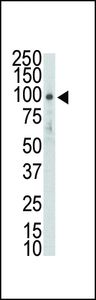
Western blot analysis of HL-60 lysate using DDR2 antibody.| Product Name | DDR2 antibody |
|---|---|
| Antibody Type | Primary Antibodies |
| Product description | Rabbit polyclonal to DDR2Protein kinases are enzymes that transfer a phosphate group from a phosphate donor, generally the g phosphate of ATP, onto an acceptor amino acid in a substrate protein. By this basic mechanism, protein kinases mediate most of the signal transduction in eukaryotic cells, regulating cellular metabolism, transcription, cell cycle progression, cytoskeletal rearrangement and cell movement, apoptosis, and differentiation. With more than 500 gene products, the protein kinase family is one of the largest families of proteins in eukaryotes. The family has been classified in 8 major groups based on sequence comparison of their tyrosine (PTK) or serine/threonine (STK) kinase catalytic domains. The tyrosine kinase (TK) group is mainly involved in the regulation of cell-cell interactions such as differentiation, adhesion, motility and death. There are currently about 90 TK genes sequenced, 58 are of receptor protein TK (e.g. EGFR, EPH, FGFR, PDGFR, TRK, and VEGFR families), and 32 of cytosolic TK (e.g. ABL, FAK, JAK, and SRC families). |
| Immunogen | Synthetic peptide CYFRSEASEWEPNAISF conjugated to KLH, corresponding to amino acids 304-320 of Human DDR2 (Accession Q16832). |
| Clonality | Polyclonal |
|---|---|
| Isotype | IgG |
| Host Species | Rabbit |
| Tested Applications | WB |
| For ELISA: Use at a dilution of 1:1,000. For WB: Use at a dilution of 1:100 - 1:500. Optimal dilutions/concentratrions should be determined by the reseracher.: |
|
| Species Reactivity | Human |
| Concentration | 0.2mg/ml |
| Purification | Protein G |
| Gene Synonyms | 191311 4921 DDR2 Q16832 NTRKR3 TYRO10 TKT |
|---|---|
| Target | DDR2 |
| Cellular Localization | Plasma membrane |
Application
Western blot analysis of HL-60 lysate using DDR2 antibody.| Positive Control | HL60 cell lysate |
|---|---|
| Application Notes | For ELISA: Use at a dilution of 1:1,000. For WB: Use at a dilution of 1:100 - 1:500. Optimal dilutions/concentratrions should be determined by the reseracher.: |
| Form | Liquid |
|---|---|
| Storage Instructions | Keep as concentrated solution. Store at 4ºC short term. For extended storage aliquot and store at -20ºC or below. Avoid freeze-thaw cycles. |
| Storage Buffer | Phosphate-buffered saline containing 0.09% sodium azide |


