Application
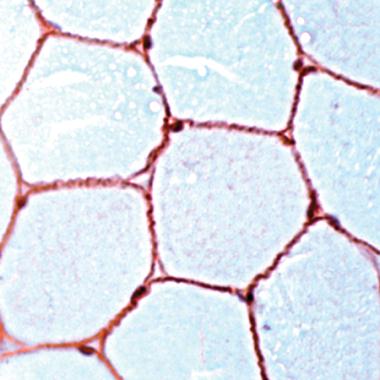
Human Skeletal Muscle stained with anti-Dystrophin antibody| Product Name | Dystrophin antibody (ready-to-use) |
|---|---|
| Antibody Type | Primary Antibodies |
| Product description | Rabbit polyclonal to Dystrophin predilutedThe dystrophin gene is the largest gene found in nature, measuring 2.4 Mb. The gene was identified through a positional cloning approach, targeted at the isolation of the gene responsible for Duchenne (DMD) and Becker (BMD) Muscular Dystrophies. DMD is a recessive, fatal, X linked disorder occurring at a frequency of about 1 in 3,500 new born males. BMD is a milder allelic form. In general, DMD patients carry mutations which cause premature translation termination (nonsense or frame shift mutations), while in BMD patients dystrophin is reduced either in molecular weight (derived from in frame deletions) or in expression level. The dystrophin gene is highly complex, containing at least eight independent, tissue specific promoters and two polyA addition sites. Furthermore, dystrophin RNA is differentially spliced, producing a range of different transcripts, encoding a large set of protein isoforms. Dystrophin (as encoded by the Dp427 transcripts) is a large, rod like cytoskeletal protein which is found at the inner surface of muscle fibers. Dystrophin is part of the dystrophin glycoprotein complex (DGC), which bridges the inner cytoskeleton (F actin) and the extracellular matrix. |
| Immunogen | A synthetic peptide corresponding to C-terminal of human Dystrophin. |
| Clonality | Polyclonal |
|---|---|
| Isotype | IgG |
| Host Species | Rabbit |
| Tested Applications | IHC-P |
| IHC-P: Working dilution, ready-to-use for 10 minutes at RT. Staining of formalin-fixed tissues requires boiling tissue sections in 1mM EDTA, pH 8.0 for 10 minutes followed by cooling at RT for 20 minutes. Optimal dilutions/concentrations should be determined by the end user.: |
|
| Species Reactivity | HumanRat |
| Concentration | 1mg/ml |
| Purification | Affinity purified |
| Gene Synonyms | Dystrophin DXS269 DXS272 1756 DXS268 DXS239 DXS270 DXS142 300376 DXS206 P11532 DXS230 DMD DXS164 BMD |
|---|
Application
Human Skeletal Muscle stained with anti-Dystrophin antibody| Application Notes | IHC-P: Working dilution, ready-to-use for 10 minutes at RT. Staining of formalin-fixed tissues requires boiling tissue sections in 1mM EDTA, pH 8.0 for 10 minutes followed by cooling at RT for 20 minutes. Optimal dilutions/concentrations should be determined by the end user.: |
|---|
| Form | Liquid |
|---|---|
| Storage Instructions | Keep as concentrated solution and store at 4°C. Do not freeze. |
| Storage Buffer | PBS, pH 7.4 containing 1%BSA and 0.1% sodium azide |


