Application
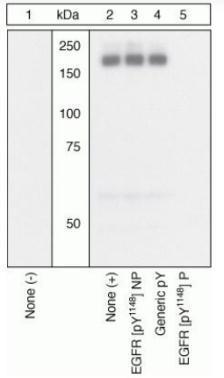
Peptide Competition. Extracts of A431 cells unstimulated (1) or stimulated with 200 ng/mL EGF (2-5) for 15 minutes were resolved by SDS-PAGE on a 10% Tris-glycine gel and transferred to PVDF. The membrane was blocked with a 5% BSA-TBST buffer for one hour at room temperature, then incubated with the EGFR (phospho Tyr1148) antibody for two hours at room temperature in a 1% BSA-TBST buffer, following prior incubation with: no peptide (1, 2), non-phosphopeptide corresponding to the phosphopeptide immunogen (3), a generic phosphotyrosine-containing peptide (4), or the phosphopeptide immunogen (5). The data show that only the phosphopeptide corresponding to EGFR (phospho Tyr1148) blocks the signal, demonstrating the specificity of the antibody. The data also show the induction of EGFR Tyr1148 phosphorylation by the addition of EGF to this cell system.| Product Name | EGFR (phospho Tyr1148) antibody |
|---|---|
| Antibody Type | Primary Antibodies |
| Product description | Rabbit polyclonal to EGFR ( phospho Y1148 )The epidermal growth factor (EGF) family of receptor tyrosine kinases consists of four receptors, EGFR (ErbB1), ErbB2 (neu), ErbB3 and ErbB4. Members of the EGFR family contain 3 domains: an extracellular domain that is involved in ligand binding and receptor dimerization, a single transmembrane domain and cytoplasmic domain. EGF exerts its actions by binding to the EGFR, a 170 kDa glycoprotein. Activation of EGFR results in initiation of diverse cellular pathways. In response to toxic environmental stimuli, or to EGF binding to the receptor, the EGFR forms homo or heterodimers with other family members. Each dimeric receptor complex initiates a distinct signaling pathway by recruiting different Src homology (SH2) containing effector proteins. Dimerization results in autophosphorylation on various residues within the cytoplasmic domain, as well as phosphorylation of intracellular substrates, initiating a downstream cascade of events. The activated EGFR dimer forms a complex with the adaptor protein Grb that is coupled to the guanine nucleotide releasing factor, SOS. The Grb- SOS complex can either bind directly to phospho tyrosine sites or indirectly through Shc. These protein interactions bring SOS in close proximity to Ras, allowing for Ras activation. This activates the Erk and JNK signaling pathways which activates transcription factors, such as c-fos, AP1 and ELK1, resulting in increased gene expression and cell proliferation. Tyrosine 1148 is situated within the cytoplasmic domain of the receptor. It is an autophosphorylation site, whose role in EGFR signal transduction is currently under investigation. |
| Immunogen | Synthetic peptide (Human). |
| Modification | p-Tyr1148 |
| Clonality | Polyclonal |
|---|---|
| Isotype | IgG |
| Host Species | Rabbit |
| Tested Applications | WB |
| WB: Use at a dilution of 1:1,000. Detects a band of approximately 170 kDa. Optimal dilutions/concentrations should be determined by the end user.: |
|
| Species Reactivity | Human |
| Concentration | 1mg/ml |
| Purification | Affinity purified |
| Gene Synonyms | ERBB1 131550 1956 EGFR EGFR phospho Y1148 ERBB mENA P00533 EGFR (phospho Y1148) EGFR (phospho Tyr1148) EGFR (pY1148) EGFR (pTyr1148) EGFR phospho Tyr1148 Phospho EGFR (Y1148) Phospho EGFR (Tyr1148) Phospho EGFR (pY1148) Phospho EGFR (pTyr1 |
|---|---|
| Target | EGFR phospho Y1148 |
| Cellular Localization | Cell Membrane and Secreted |
Application
Peptide Competition. Extracts of A431 cells unstimulated (1) or stimulated with 200 ng/mL EGF (2-5) for 15 minutes were resolved by SDS-PAGE on a 10% Tris-glycine gel and transferred to PVDF. The membrane was blocked with a 5% BSA-TBST buffer for one hour at room temperature, then incubated with the EGFR (phospho Tyr1148) antibody for two hours at room temperature in a 1% BSA-TBST buffer, following prior incubation with: no peptide (1, 2), non-phosphopeptide corresponding to the phosphopeptide immunogen (3), a generic phosphotyrosine-containing peptide (4), or the phosphopeptide immunogen (5). The data show that only the phosphopeptide corresponding to EGFR (phospho Tyr1148) blocks the signal, demonstrating the specificity of the antibody. The data also show the induction of EGFR Tyr1148 phosphorylation by the addition of EGF to this cell system.| Positive Control | Human epithelial A431 cells stimulated with EGF or mouse hybridoma NIH3T3 cells expressing human EGFR and stimulated with EGF. |
|---|---|
| Application Notes | WB: Use at a dilution of 1:1,000. Detects a band of approximately 170 kDa. Optimal dilutions/concentrations should be determined by the end user.: |
| Form | Liquid |
|---|---|
| Storage Instructions | Aliquot and store at -20°C or -80°C. Avoid repeated freeze / thaw cycles. |
| Storage Buffer | Preservative: 0.05% Sodium Azide; Constituents: PBS, 50% glycerol, 1mg/ml BSA. pH 7.4 |


