Application
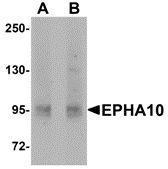
Western blot analysis of EphA10 in 293 cell lysate with EphA10 antibody at (A) 1 ug/ml and (B) 2 ug/ml.| Product Name | EphA10 antibody |
|---|---|
| Antibody Type | Primary Antibodies |
| Product description | Rabbit polyclonal antibody to EphA10Eph receptors, the largest subfamily of receptor tyrosine kinases (RTKs), and their ephrin ligands are important mediators of cell–cell communication regulating cell attachment, shape, and mobility of neuronal and endothelial cells in central nervous system function and in development. Eph receptors can be divided into two subgroups: EphA and EphB. In mammals, the EphA class consists of eight members (EphA 1-7 and 10) that in general bind to ephrin-A members linked to the cell membrane through a glycosylphosphatidylinositol linkage. The EphB class consists of six members (EphB 1-6) that in general bind ephrin-B members that transverse the cell membrane. The Ephrin / EPH signaling pathway networks with the WNT signaling pathway during embryogenesis, tissue regeneration, and carcinogenesis. Recent studies show that Eph/EFN might be relevant in normal B-cell biology and could represent new potential prognostic markers and therapeutic targets for CLL. |
| Immunogen | immunogen is generated from within aa121-180 of NP_001092909. |
| Clonality | Polyclonal |
|---|---|
| Host Species | Rabbit |
| Tested Applications | ELISAWB |
| WB:1:500~1:2000 Notes:Optimal dilutions/concentrations should be determined by the researcher. |
|
| Species Reactivity | HumanMouseRat |
| Concentration | 1mg/ml |
| Purification | Affinity purified |
| Gene Synonyms | EPH receptor A10 EphA10 FLJ16103 Ephrin type-A receptor 10 Ephrin typeA receptor 10 Ephrin typeA receptor10 Ephrin type A receptor 10 |
|---|---|
| Target | EphA10 |
| Tissue Specificity | This antibody is specific for EphA10 |
Application
Western blot analysis of EphA10 in 293 cell lysate with EphA10 antibody at (A) 1 ug/ml and (B) 2 ug/ml.| Positive Control | Blocking Peptide: Cat.No. GTX85273-PEP - EphA10 Peptide Lysates: Cat. No. GTX27902 - 293 Cell Lysate |
|---|---|
| Application Notes | WB:1:500~1:2000 Notes:Optimal dilutions/concentrations should be determined by the researcher. |
| Form | Liquid |
|---|---|
| Storage Instructions | Keep as concentrated solution. Aliquot and store at -20ºC or below. Avoid multiple freeze-thaw cycles. |
| Storage Buffer | PBS containing 0.02% sodium azide |


