Application
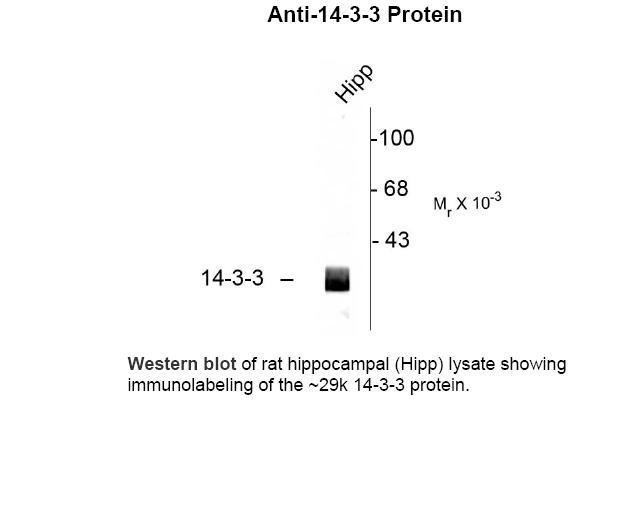
Western blot of rat hippocampal (Hipp) lysate showing immunolabeling of the ~29k 14-3-3 protein.| Product Name | 14-3-3 Antibody |
|---|---|
| Antibody Type | Primary Antibodies |
| Product description | 14-3-3 proteins are a family of highly conserved proteins that appear to have multiple roles in cell signaling (Bridges and Moorhead, 2005). The proteins are abundantly expressed in the brain and have been detected in the cerebrospinal fluid of patients with different neurological disorders (Berg et al., 2003). 14-3-3 proteins bind protein ligands that are typically phosphorylated on serine or threonine residues and regulate the functions of these binding partners by a number of different mechanisms (Silhan et al., 2004; Dougherty and Morrison, 2004). The 14-3-3 proteins affect a diverse array of cellular processes including the cell cycle and transcription, signal transduction and intracellular trafficking.1) Berg D, Holzmann C, Riess O (2003) 14-3-3 Proteins in the nervous system. Nat Rev Neurosci 4:752-762. |
| Immunogen | Peptide corresponding to amino acid residues from the C-terminal region of 14-3-3 protein, conjugated to keyhole limpet hemocyanin (KLH). |
| Clonality | Polyclonal |
|---|---|
| Host Species | Rabbit |
| Tested Applications | WB |
| The antibody has been directly tested for reactivity in Western blots with rat tissue. It is anticipated that the antibody will react with bovine, canine, chicken, human, mouse, non-human primates, Xenopus and zebra fish based on the fact that these species have 100% homology with the amino acid sequence used as antigen.: |
|
| Species Reactivity | BovineXenopus |
| Concentration | 1mg/ml |
| Purification | Affinity purified |
| Gene Symbol | Ywhab |
|---|---|
| Molecular Weight(MW) | 29 |
Application
Western blot of rat hippocampal (Hipp) lysate showing immunolabeling of the ~29k 14-3-3 protein.| Application Notes | The antibody has been directly tested for reactivity in Western blots with rat tissue. It is anticipated that the antibody will react with bovine, canine, chicken, human, mouse, non-human primates, Xenopus and zebra fish based on the fact that these species have 100% homology with the amino acid sequence used as antigen.: |
|---|
| Form | Liquid |
|---|---|
| Storage Instructions | 14-3-3 antibody can be stored at -20˚C and is stable at -20˚C for at least 1 year. |
| Storage Buffer | 100 uL in 10 mM HEPES (pH 7.5), 150 mM NaCl, 100 ug per mL BSA and 50% glycerol. |


